
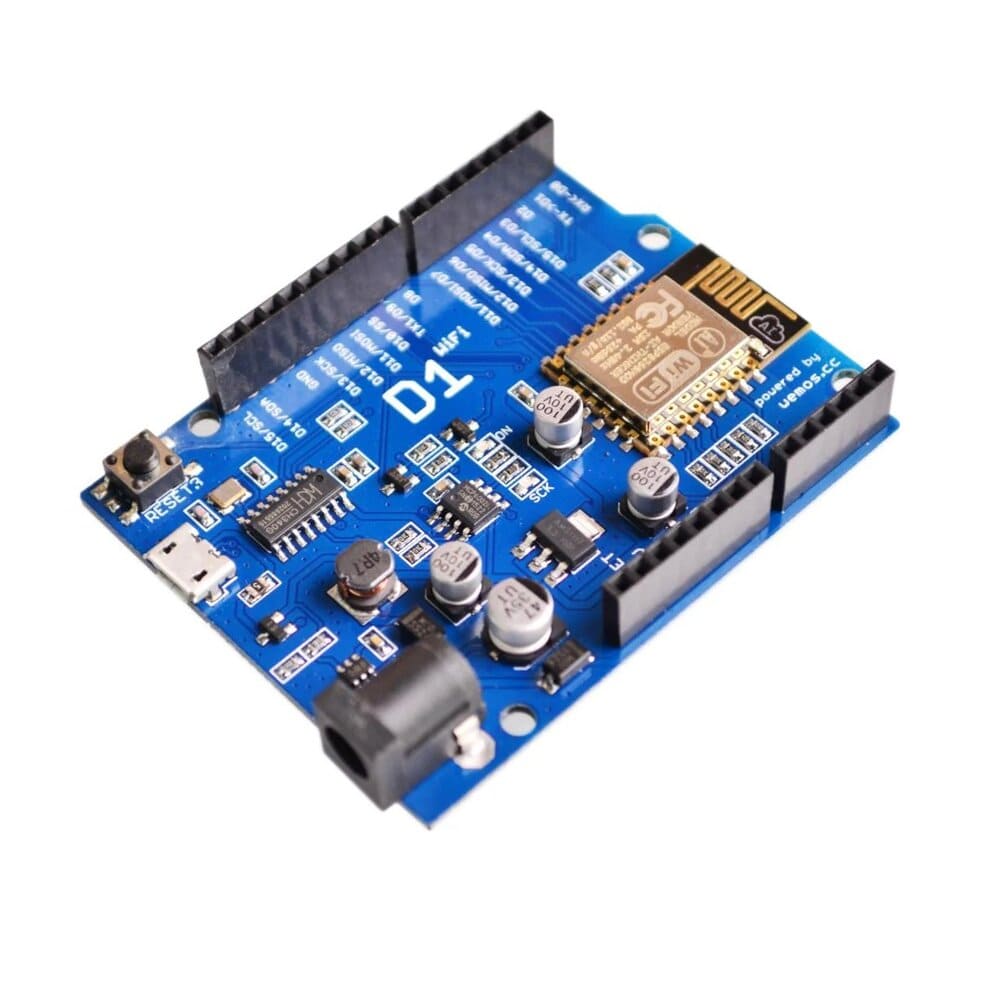

WeMos D1 R2 ESP8266 Wi-Fi UNO Compatible Development Board is a wireless IoT development board that integrates the Espressif ESP-12F (ESP8266EX) 32-bit 80/160 MHz Wi-Fi module onto a full-size Arduino UNO R3 footprint. Furthermore, the Revision 2 (R2) board rearranges its GPIO header mapping to align with the WeMos D1 Mini pin numbering and replaces the legacy linear regulator with a high-efficiency switch-mode DC-DC buck converter on the 9V–24V barrel jack input. Consequently, developers can program it directly from the Arduino IDE over Micro-USB to build Wi-Fi web servers, MQTT clients, and OTA-updatable smart home controllers.
Key Features:
- Integrated ESP-12F (ESP8266EX) Wi-Fi Module: 32-bit Tensilica L106 RISC processor running at 80 MHz or 160 MHz with 4MB (32Mbit) SPI Flash and 802.11b/g/n 2.4GHz Wi-Fi.
- Standard Arduino UNO R3 Form Factor: Matches the 68.6mm × 53.4mm mechanical outline and mounting holes of the Arduino UNO R3.
- Switch-Mode Buck Power Supply (9V–24V DC): Onboard step-down switching regulator converts 9V–24V DC barrel-jack power into a stable 5V/1A and 3.3V rail without overheating.
- Onboard CH340G & Auto-Reset Bootloader: Connects via Micro-USB for one-click sketch uploads from the Arduino IDE (`LOLIN(WEMOS) D1 R2 & mini`) or PlatformIO.
- Built-In 0V–3.2V Analog Divider on A0: Onboard 220kΩ / 100kΩ resistor voltage divider scales the ESP8266’s raw 0–1.0V ADC input up to a 0–3.2V range on the `A0` header pin.
Technical Specifications:
- Microcontroller / Wi-Fi SoC: Espressif ESP8266EX (ESP-12F Shielded Module)
- CPU Clock Speed: 80 MHz Default / 160 MHz Overclocked
- Flash Memory: 4 MB (32 Mbit) SPI NOR Flash
- Wireless Standard: IEEE 802.11 b/g/n 2.4 GHz (Station, SoftAP, and Wi-Fi Direct Modes)
- Operating Logic Voltage: Strictly 3.3V DC on All Digital I/O Pins
- External Input Voltage (DC Jack / VIN): 9.0V to 24.0V DC Recommended (7V–24V Range)
- Digital I/O Pins: 11 GPIO Pins (`D0–D8, RX, TX`; All Digital Pins Except `D0/GPIO16` Support Interrupts, PWM, I2C, and One-Wire)
- Analog Input Pin: 1 Channel (`A0`, 10-Bit ADC, 0V–3.2V Input Range)
Mechanical Specifications:
- PCB Substrate: Blue Double-Sided FR-4 Fiberglass PCB in Arduino UNO R3 Outline
- Connectors: Micro-USB Type-B Female Port, 5.5mm × 2.1mm DC Barrel Jack, Tactile Reset Switch
- Antenna: Integrated 2.4GHz Meandered PCB Trace Antenna on ESP-12F Module
Dimensions:
- Length: 68.6 mm
- Width: 53.4 mm
- Height: 12.5 mm
- Weight: ≈ 25 g
Pinout and Wiring:
- D1 R2 GPIO Mapping: `D0 (GPIO16), D1 (GPIO5 / SCL), D2 (GPIO4 / SDA), D3 (GPIO0), D4 (GPIO2 / Built-in LED), D5 (GPIO14 / SCK), D6 (GPIO12 / MISO), D7 (GPIO13 / MOSI), D8 (GPIO15 / SS), RX (GPIO3), TX (GPIO1)`.
- Analog Input (`A0`): Accepts 0V to 3.2V DC analog signals (scaled to 0–1.0V at the ESP8266 `TOUT` pin).
- Power Header (`3.3V, 5V, GND, VIN`): Provides regulated 3.3V and 5V rails for external sensors and relay boards.
- Engineering Precaution: All digital pins on the WeMos D1 R2 operate at 3.3V logic and are NOT 5V-tolerant; also avoid pulling `D3 (GPIO0)` or `D4 (GPIO2)` LOW or pulling `D8 (GPIO15)` HIGH during power-up, as those three strapping pins control the ESP8266 boot mode.
Datasheet Reference:
Commonly Used in:
- ESPHome, Tasmota, and Blynk Smart Home Wi-Fi Relay & Sensor Hubs
- Standalone HTTP Web Server Dashboards and REST API Weather Stations
- Wireless Over-The-Air (OTA) Programmable Automation Controllers
Applications:
- Industrial 12V/24V Cabinet IoT Nodes: Powers directly from a 12V or 24V DC control-panel supply rail via its onboard switching buck regulator.
- MQTT Environmental Telemetry: Reads I2C BME280/SHT31 sensors on `D1 (SCL)` / `D2 (SDA)` and publishes JSON payloads to Home Assistant.
- UNO Enclosure Drop-In Wi-Fi Upgrade: Mounts inside standard Arduino UNO R3 DIN-rail holders and acrylic cases.
Equivalent Models:
- ESP32 UNO D1 R32 Board: Upgrades to a dual-core 240MHz ESP32 with Bluetooth 4.2/BLE and 6 analog inputs in the same UNO R3 footprint.
- D1 Mini V2 NodeMCU (ESP8266 4MB): Ultra-compact 34×25mm breadboard version of the WeMos D1 R2 using the exact same GPIO mapping (`D0–D8`).
- NodeMCU V3 ESP8266 CH340 Board: 30-pin DIP-style breadboard development board without the DC barrel jack or UNO shield headers.
Package Includes:
- 1 × WeMos D1 R2 ESP8266 Wi-Fi UNO Compatible Development Board





Reviews
No reviews yet. Be the first to share your experience!