


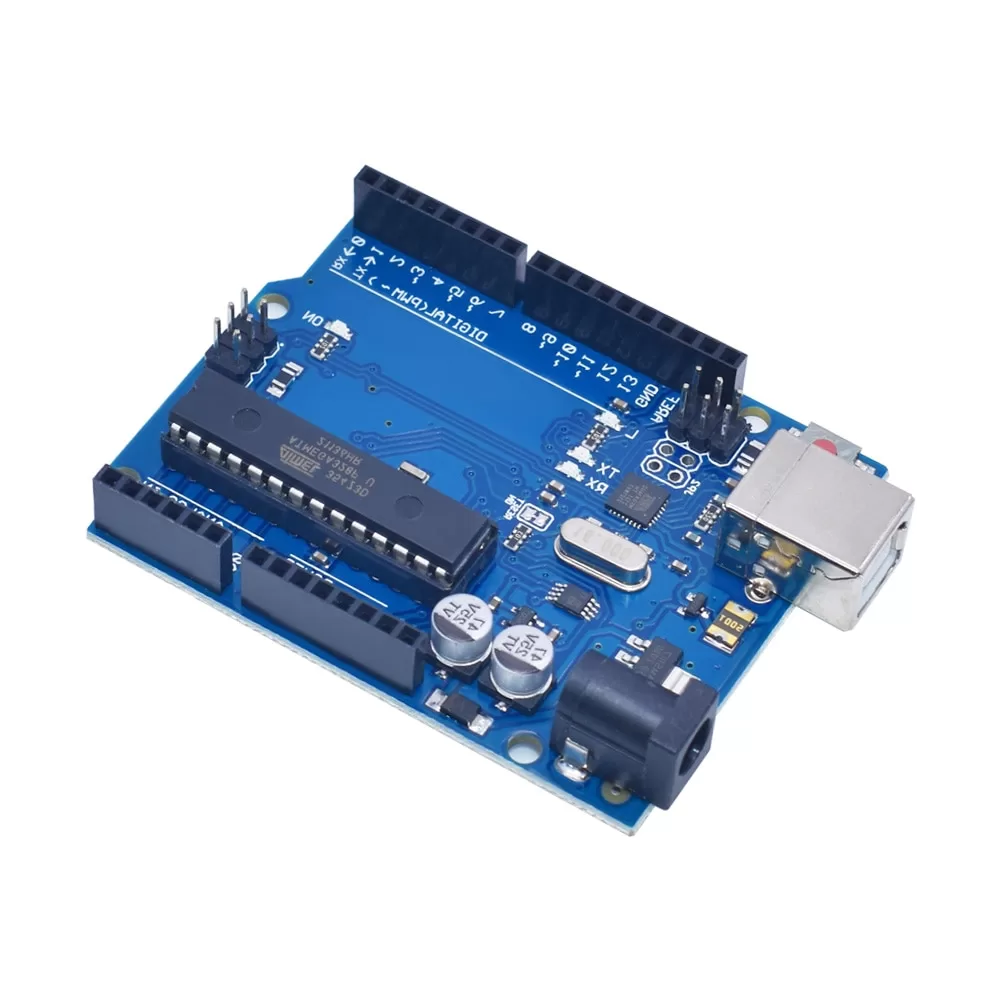
Arduino Compatible Leonardo R3 ATmega32U4 USB Development Board is a native-USB 8-bit AVR microcontroller development board powered by the Microchip/Atmel ATmega32U4 running at 16 MHz. Furthermore, because the ATmega32U4 integrates a hardware Full-Speed USB 2.0 transceiver directly inside the main MCU silicon, the board eliminates external USB-to-serial bridge chips and can natively emulate a USB HID keyboard, mouse, joystick, or MIDI device. Consequently, it is the go-to UNO-footprint board for sim-racing force-feedback steering wheels, custom game controllers, and automated USB input peripherals.
Key Features:
- Native On-Chip USB 2.0 Controller: Built-in ATmega32U4 USB transceiver enables out-of-the-box USB Keyboard (`Keyboard.h`), Mouse (`Mouse.h`), Gamepad, and USB-MIDI emulation alongside virtual CDC serial(`Serial`).
- Independent Hardware UART (`Serial1`): Because USB communication is handled internally over `Serial`, digital pins `D0 (RX)` and `D1 (TX)` remain 100% free as an independent hardware UART (`Serial1`) for GPS, GSM, or Bluetooth modules.
- Expanded 12-Channel Analog Input & 7 PWM Outputs: Provides 20 digital I/O pins, 7 PWM channels, and up to 12 channels of 10-bit ADC (A0–A5 plus D4, D6, D8, D9, D10, D12).
- 2.5KB SRAM (25% More than UNO R3): Extra 512 bytes of internal RAM over the ATmega328P accommodates USB endpoint buffers and larger sensor arrays.
- Standard UNO R3 Shield Form Factor: Matches the 68.6mm × 53.4mm UNO R3 header layout with Micro-USB connectivity and a 7V–12V DC barrel jack.
Technical Specifications:
- Microcontroller: Microchip / Atmel ATmega32U4 (8-Bit AVR @ 16 MHz with Built-In USB)
- Operating Voltage: 5.0V DC
- Input Voltage (DC Barrel Jack / VIN): 7.0V to 12.0V DC Recommended (6V–20V Limits)
- Digital I/O Pins: 20 Pins (D0–D13 and A0–A5)
- PWM Channels: 7 Pins (D3, D5, D6, D9, D10, D11, D13)
- Analog Input Channels (10-Bit ADC): 12 Pins (A0–A5, A6/D4, A7/D6, A8/D8, A9/D9, A10/D10, A11/D12)
- Memory: 32 KB Flash (4 KB Used by Caterina Bootloader), 2.5 KB SRAM, 1 KB EEPROM
- USB Interface: Micro-USB Type-B Receptacle
Mechanical Specifications:
- PCB Layout: Standard Arduino R3 1.0 Pinout (Includes Dedicated SDA/SCL Pins Near AREF)
- Onboard Connectors: Micro-USB Port, 5.5mm × 2.1mm DC Power Jack, 6-Pin ICSP Header, Reset Button
- Mounting Holes: 4 × 3.2mm (M3) Standard UNO/Leonardo Mounting Holes
Dimensions:
- Length: 68.6 mm
- Width: 53.4 mm
- Height: 12.5 mm
- Weight: ≈ 20 g
Pinout and Wiring:
- I2C Bus (`D2 / SDA` and `D3 / SCL`): Unlike the ATmega328P UNO (which maps I2C to A4/A5), the Leonardo maps hardware I2C to `D2 (SDA)` and `D3 (SCL)` as well as the top dedicated `SDA/SCL` header pins.
- SPI Bus (6-Pin ICSP Header Only): Hardware SPI (`MOSI, MISO, SCK`) is routed strictly to the 6-pin ICSP header and NOT to digital pins D11–D13.
- Hardware UART (`Serial1` on D0 RX / D1 TX): Dedicated TTL serial port completely separate from the USB `Serial` monitor.
- External Interrupts: 5 Interrupt Pins (`D3/INT0, D2/INT1, D0/INT2, D1/INT3, D7/INT4`).
- Engineering Precaution: When using SPI shields (such as Ethernet or SD shields) with the Leonardo R3, verify that the shield connects to the 6-pin center ICSP header, as pins D11–D13 do not carry hardware SPI signals on the ATmega32U4.
Datasheet Reference:
Commonly Used in:
- DIY Sim-Racing Direct-Drive / Encoder Steering Wheels, Pedals, and Handbrakes
- Custom Arcade Fight Sticks, Flight Simulator Switch Panels, and MIDI Foot Controllers
- Hardware USB Keyboard Macro Injectors and Assistive Accessibility Input Devices
Applications:
- Direct-Input Game Controllers: Uses the Arduino `Joystick` and FFB libraries with rotary encoders to create plug-and-play Windows/Linux sim-racing controllers.
- Dual-Serial Bridge Systems: Reads a hardware GPS or RS485 sensor on `Serial1` (D0/D1) at 115200 baud while streaming formatted logs to a PC over native USB `Serial`.
- Hands-Free Workstation Automation: Converts foot switches, capacitive pads, or analog joysticks into native OS mouse and keyboard actions.
Equivalent Models:
- SparkFun Pro Micro (ATmega32U4): Uses the exact same 16MHz ATmega32U4 chip in a miniature breadboard-friendly 24-pin DIP form factor without shield headers.
- Arduino UNO R3 (ATmega328P): Standard 14-digital / 6-analog UNO board with SPI on D10–D13, whereas the Leonardo R3 provides native USB HID emulation, 12 analog inputs, and separate USB/UART serial ports.
- RP2040 Pro Micro / Raspberry Pi Pico: 3.3V 32-bit dual-core native-USB boards when 5V logic and UNO shield compatibility are not required.
Package Includes:
- 1 × Arduino Compatible Leonardo R3 ATmega32U4 USB Development Board






Reviews
No reviews yet. Be the first to share your experience!