
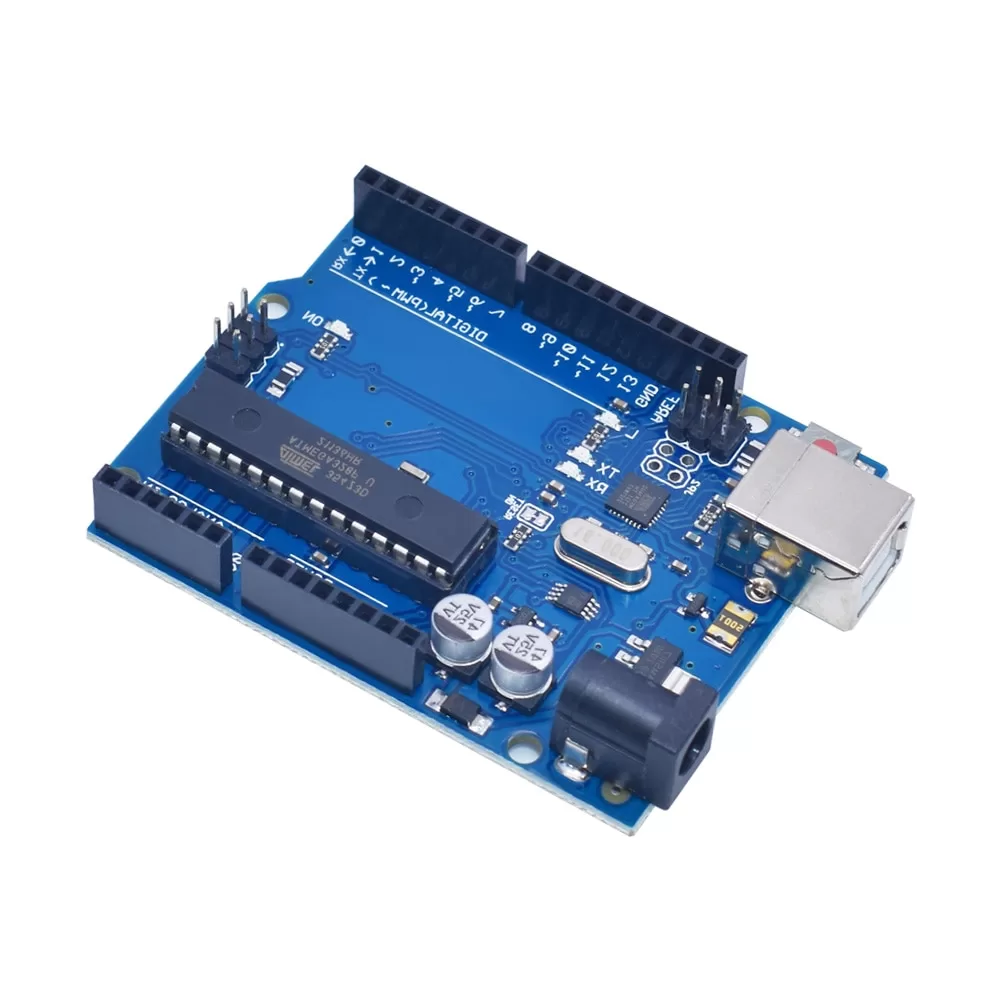
Arduino Compatible UNO R3 ATmega328P ATmega16U2 USB Development Board is a faithful 1:1 hardware implementation of the official Arduino UNO Revision 3 architecture, pairing the Microchip/Atmel ATmega328P main microcontroller with a dedicated ATmega16U2 USB-to-serial coprocessor. Furthermore, because it uses the official ATmega16U2 USB bridge instead of a third-party CH340 chip, it enumerates natively in the Arduino IDE on Windows, macOS, and Linux as a genuine Arduino UNO without installing extra drivers. Consequently, it also supports DFU reprogramming of the ATmega16U2 chip to turn the UNO into a native USB HID keyboard, mouse, MIDI, or joystick device.
Key Features:
- True ATmega16U2 USB Coprocessor: Matches the official Arduino.cc UNO R3 schematic for zero-driver plug-and-play recognition and optional HoodLoader2 / Atmel FLIP USB HID DFU flashing.
- 16 MHz ATmega328P Main Microcontroller: Delivers 32KB Flash, 2KB SRAM, 1KB EEPROM, 14 digital I/O pins (6 PWM), and 6 channels of 10-bit analog input.
- Dual 6-Pin ICSP Headers: Includes both the main ATmega328P ICSP header and the dedicated 6-pin ATmega16U2 ICSP header next to the USB-B port.
- Auto-Selecting Power Multiplexer: Onboard comparator and P-channel MOSFET seamlessly switch between 5V USB power and 7V–12V external DC barrel-jack power.
- Resettable 500mA USB Polyfuse: Protects your host computer’s USB port against accidental short circuits on the 5V breadboard rail.
Technical Specifications:
- Main Microcontroller: Microchip / Atmel ATmega328P (8-Bit AVR @ 16 MHz)
- USB-to-Serial Processor: Microchip / Atmel ATmega16U2-MU (With Dedicated 16 MHz Crystal & ICSP Header)
- Operating Voltage: 5.0V DC
- Recommended Input Voltage (DC Jack / VIN): 7.0V to 12.0V DC (6V–20V Absolute Limits)
- Digital I/O Pins: 14 Pins (D0–D13; 6 Pins Provide 8-Bit PWM: D3, D5, D6, D9, D10, D11)
- Analog Input Pins: 6 Pins (A0–A5, 10-Bit SAR ADC, 0V–5V)
- DC Current Rating: 20 mA per I/O Pin (40 mA Max) | 50 mA–150 mA on 3.3V Pin
- Memory: 32 KB Flash (0.5 KB Used by Optiboot), 2 KB SRAM, 1 KB EEPROM
Mechanical Specifications:
- PCB Layout: Official Arduino UNO Revision 3.0 Footprint (Includes `SDA`, `SCL`, and `IOREF` Pins)
- Connectors: Standard USB Type-B Female Port, 5.5mm × 2.1mm Center-Positive DC Barrel Jack, 2 × 6-Pin ICSP Headers
- Mounting Holes: 4 × 3.2mm (M3) Mounting Holes
Dimensions:
- Length: 68.6 mm
- Width: 53.4 mm
- Height: 15.0 mm
- Weight: ≈ 25 g
Pinout and Wiring:
- Power Header (`IOREF, RESET, 3.3V, 5V, GND, GND, VIN`): `IOREF` provides a 5V logic reference to shields; `VIN` accepts 7V–12V external DC power.
- Analog & I2C (`A0–A5` & Top `SDA/SCL`): 6 analog inputs; `A4` and `A5` are internally tied to the top-left `SDA` and `SCL` pins.
- Digital, UART & SPI (`D0–D13`): `D0 (RX) / D1 (TX)` connect to the ATmega16U2; `D10 (SS), D11 (MOSI), D12 (MISO), D13 (SCK)` mirror the main 6-pin ICSP header.
- Engineering Precaution: Do not power the board simultaneously via a 12V DC barrel jack while drawing more than 250mA total from the `5V` pin for external servo motors, as the linear drop ($(12text{V} – 5text{V}) times I$) will heat the onboard 5V LDO regulator; always power servos from a dedicated 5V/6V supply with common `GND`.
Datasheet Reference:
Commonly Used in:
- University Embedded C/AVR Courses Requiring Official UNO R3 Hardware Compatibility
- Custom USB-MIDI Controllers and HoodLoader2 Dual-MCU Projects
- Robotics Prototyping, Automated Test Fixtures, and Shield-Stacking Systems
Applications:
- Zero-Driver Classroom Deployment: Plugs into locked-down school and university lab computers where installing third-party CH340 drivers is restricted by IT policy.
- Custom USB HID / MIDI Firmware: Uses Atmel FLIP or `dfu-programmer` on the ATmega16U2 to convert the board into a native class-compliant USB MIDI instrument.
- Universal Shield Host: Drives W5100 Ethernet, SIM900 GSM, L293D/L298P motor, and TFT LCD shields seamlessly.
Equivalent Models:
- Arduino UNO R3 DIP CH340G Board: Uses a WCH CH340G USB-serial chip at a lower cost (requires the standard CH340 driver on older OS versions).
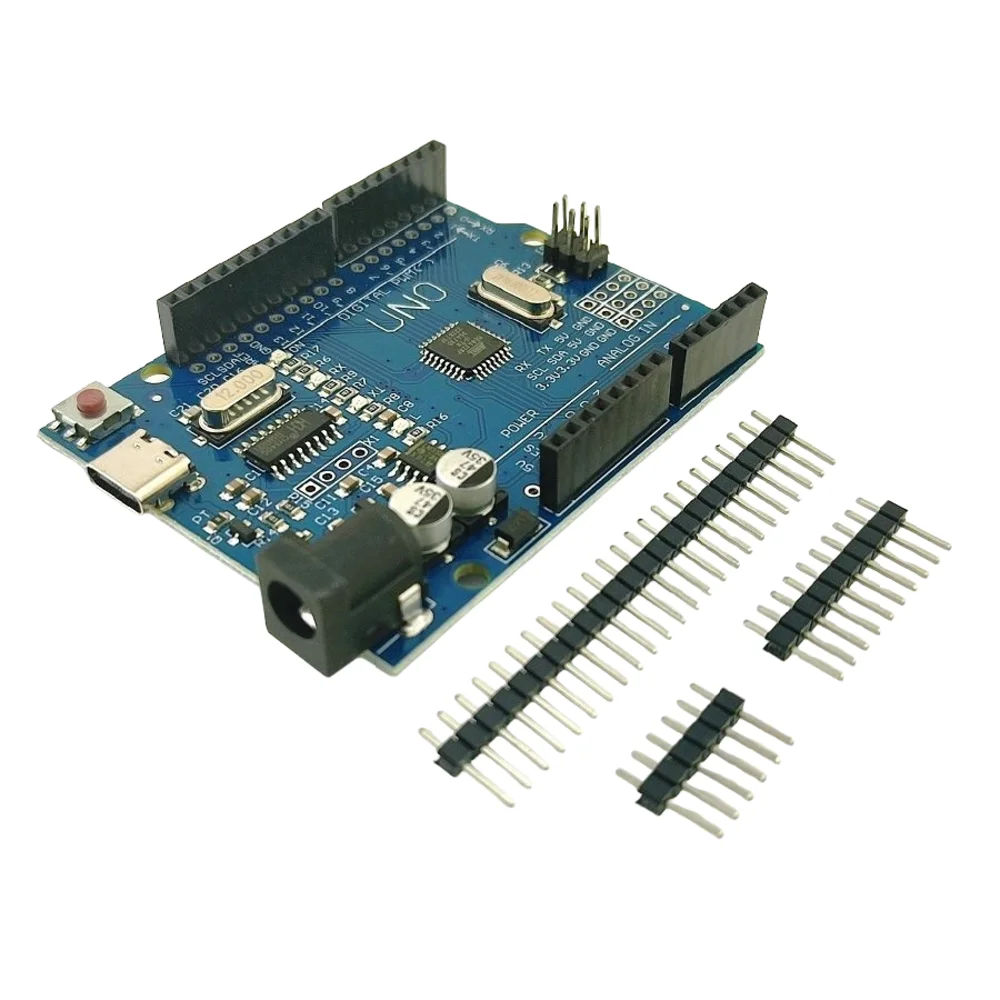
- Arduino UNO R3 Type-C Development Board: Replaces the USB-B socket with a modern USB Type-C port.
- Arduino Leonardo R3 (ATmega32U4): Single-chip native USB AVR board when you want `Keyboard.h` / `Mouse.h` support directly in your main sketch without DFU flashing.
Package Includes:
- 1 × Arduino Compatible UNO R3 ATmega328P ATmega16U2 USB Development Board





Reviews
No reviews yet. Be the first to share your experience!