
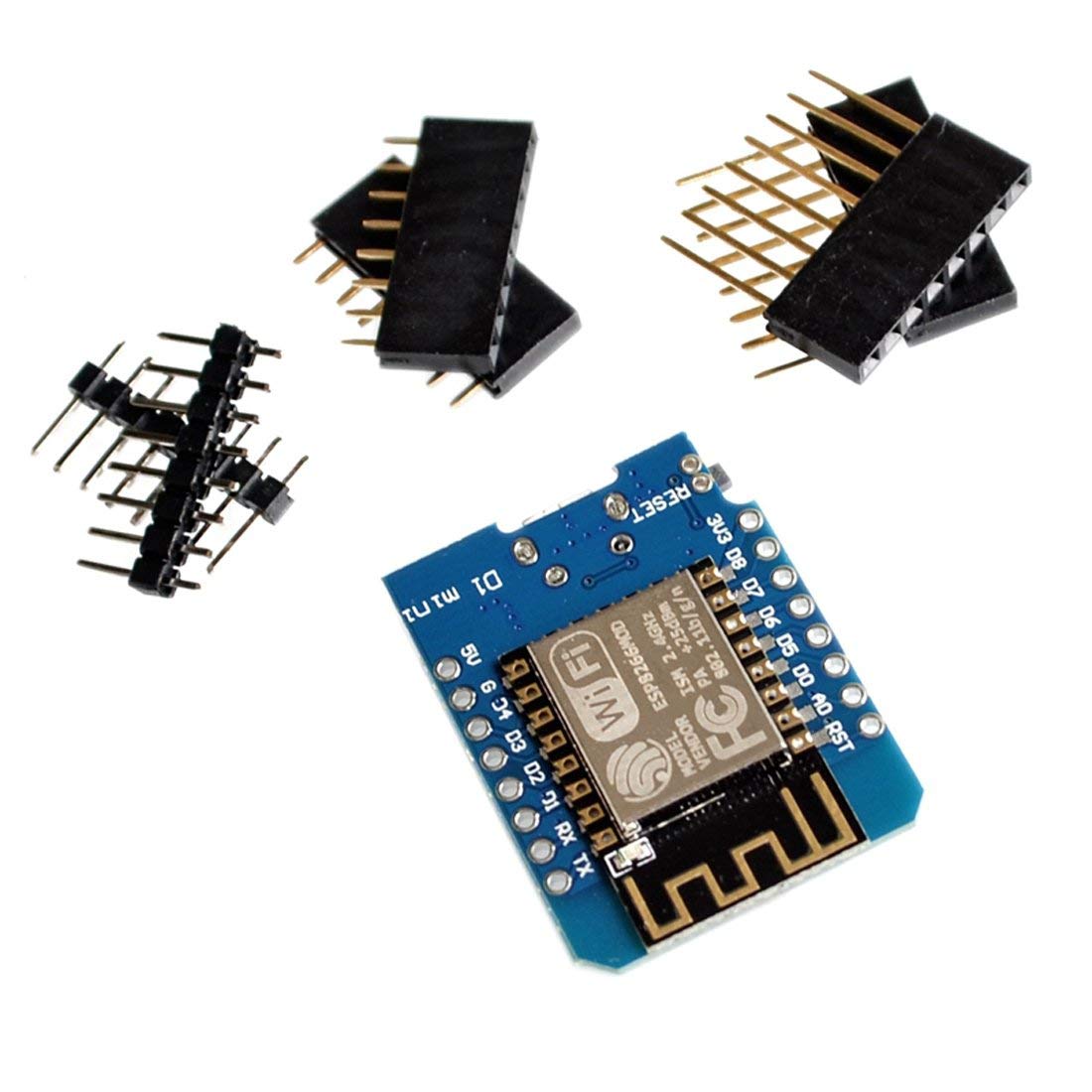
D1 Mini V2 NodeMCU 4M Bytes Development Board is an ultra-compact, high-performance Wi-Fi development board based on the ESP8266EX microcontroller, designed to offer a balance between power and portability. This version 2 iteration features a redesigned PCB for enhanced stability and 4MB of flash memory to handle complex scripts and large firmware projects. Consequently, it remains one of the most popular choices for developers who require a small footprint without sacrificing wireless capability. Furthermore, the board integrates a CH340G USB-to-Serial converter, allowing you to program the device directly via a Micro-USB cable using the Arduino IDE or MicroPython. Therefore, you can rapidly prototype Internet of Things (IoT) applications with minimal setup time and maximum efficiency.
Key Features:
- Expanded Memory: Includes 4M bytes of flash memory, providing ample space for storing large web pages, data logs, and extensive program code.
- Plug-and-Play Connectivity: The integrated CH340G chip ensures seamless communication between the computer and the ESP8266, simplifying the firmware flashing process.
- Breadboard Friendly: Features a small, 11-pin header layout that fits perfectly into standard breadboards for fast circuit experimentation.
- Wireless Versatility: Supports 802.11 b/g/n Wi-Fi protocols, enabling the device to function as an access point, a station, or both simultaneously.
- Peripheral Support: Offers 11 digital input/output pins, all of which support interrupt, PWM, I2C, and one-wire communication (except D0).
Technical Specifications:
- Microcontroller: ESP8266EX
- Operating Voltage: 3.3 V
- Digital I/O Pins: 11
- Analog Input Pins: 1 (Max input: 3.2 V)
- Clock Speed: 80 MHz / 160 MHz
- Flash Memory: 4M Bytes (32M bits)
- USB-Serial Chip: CH340G
- Wi-Fi Range: ≈ 100 meters (Open space)
Mechanical Specifications:
- PCB Material: High-quality FR-4 glass epoxy
- Mounting Type: Through-hole (Standard headers provided)
- Connector Type: Micro-USB Female
- Finish: Lead-free solder finish with protective silk screen
Dimensions:
- Length: 34.2 mm
- Width: 25.6 mm
- Weight: ≈ 3.0 g
- Pin Pitch: 2.54 mm
Pinout and Wiring:
- 5V Pin: Power input from USB or external 5V source; the onboard regulator converts this to 3.3V.
- 3V3 Pin: Regulated 3.3V output for powering sensors and low-power peripherals.
- D1 & D2: Commonly used for I2C communication (SCL and SDA respectively).
- A0: The single analog input pin, ideal for reading potentiometer or sensor values.
- RST: Reset pin; pull this low to restart the microcontroller manually.
- Note: However, always ensure your sensors operate at 3.3V logic to avoid damaging the ESP8266 pins.
Datasheet Reference:
Commonly Used in:
- Smart Home Hubs: Centralizing control for Wi-Fi enabled switches and smart plugs.
- Weather Stations: Transmitting atmospheric data to online dashboards like ThingSpeak or Blynk.
- Maker Projects: Serving as the “brain” for DIY robots and interactive art installations.
Applications:
- Remote Monitoring: Collecting temperature, humidity, or soil moisture data over long distances via local Wi-Fi.
- Wireless Web Servers: Hosting small, interactive web pages to control hardware directly from a smartphone browser.
- IoT Prototyping: Testing cloud-based automation logic before scaling to industrial hardware.
Equivalent Models:
- NodeMCU V3 (ESP-12E): A larger development board with more GPIO pins but a significantly bigger footprint.
- ESP-01S: A smaller module suited for basic Wi-Fi tasks, however, it lacks an onboard USB-to-Serial converter.
- Wemos D1 Mini Pro: A premium version featuring an external antenna connector and 16MB of flash memory.
Package Includes:
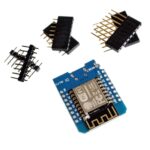
- 1 x D1 Mini V2 NodeMCU 4M Bytes Development Board
- 2 x 8-pin Male Header Rows
- 2 x 8-pin Female Header Rows
- 2 x 8-pin Long Female Header Rows


Reviews
No reviews yet. Be the first to share your experience!