
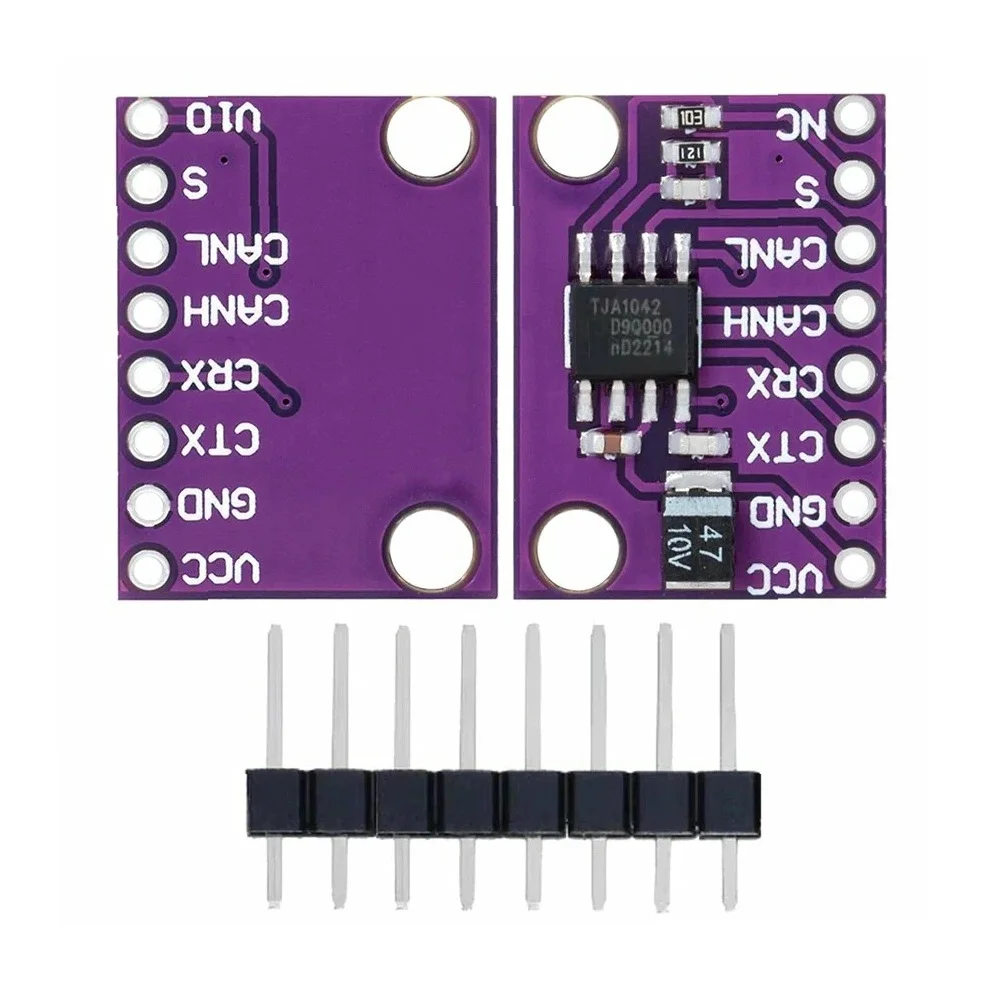
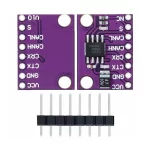
TJA1042 High Speed Low Power Consumption CAN Transceiver Module acts as the vital physical interface between a Controller Area Network (CAN) protocol controller and the physical differential bus lines. This advanced module utilizes the NXP TJA1042 transceiver IC, delivering excellent high-speed performance up to 1 Mbps for modern automotive and industrial networks. Consequently, it guarantees dependable data packet transmission even in environments with heavy electromagnetic interference. Furthermore, the board features a dedicated low-power standby mode that drastically reduces current consumption when the network remains idle. Therefore, you can seamlessly integrate this module into automotive diagnostics, industrial automation, and robotic systems to achieve optimized, energy-efficient CAN bus communications.
Key Features:
- High-Speed Communication: Supports data rates up to 1 Mbps, fully complying with ISO 11898-2 and ISO 11898-5 international network standards.
- Low-Power Standby Mode: Incorporates a smart standby state that switches off the transmitter while maintaining bus wake-up capability to preserve system energy.
- Advanced Electrostatic Protection: Provides robust Electrostatic Discharge (ESD) protection up to ±8 kV on the bus pins, safeguarding internal components from voltage spikes.
- Excellent EMC Performance: Features very low Electromagnetic Emission (EME) alongside high Electromagnetic Immunity (EMI) without requiring an external common-mode choke.
- VIO Pin Architecture: Includes a dedicated VIO supply pin that allows direct interfacing with 3.3 V and 5 V microcontrollers without external level shifters.
Technical Specifications:
- Supply Voltage (VCC): 4.5 V to 5.5 V
- I/O Interface Voltage (VIO): 2.8 V to 5.5 V (For logic compatibility)
- Maximum Data Rate: 1 Mbps
- Bus Voltage Protection: −58 V to +58 V (On CANH and CANL pins)
- Standby Current Consumption: ≈ 10 μA (Typical at low power)
- Common-Mode Input Voltage: −30 V to +30 V
- Operating Temperature Range: −40°C to +150°C (Automotive Grade)
Mechanical Specifications:
- Core Chipset: NXP TJA1042T
- PCB Material: High-quality FR4 double-sided board
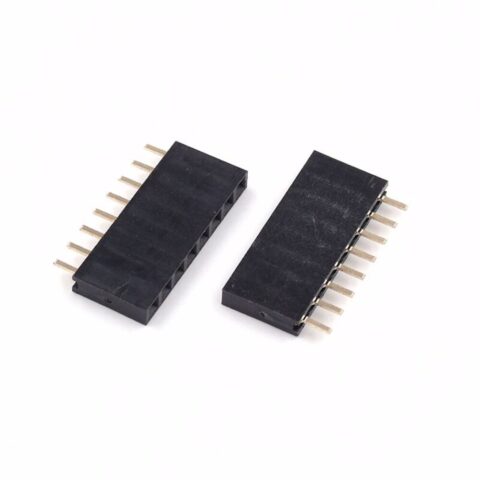
- Mounting Hardware: Standard 2.54 mm pin headers for breadboard or chassis integration
- Bus Connection: Heavy-duty screw terminal or pin headers for secure bus wire attachment
Dimensions:
- Module Length: ≈ 22.0 mm
- Module Width: ≈ 14.5 mm
- Module Height: ≈ 11.5 mm (Including screw terminal block)
- Pin Pitch: 2.54 mm (0.1 inch)
- Weight: ≈ 3.5 g
Pinout and Wiring:
- VCC: Connect to a stable 5 V DC power supply to drive the main transceiver circuitry.
- GND: Connect to the common system ground reference loop.
- TXD: Transmit Data Input. Connect this pin directly to the CAN controller TX pin.
- RXD: Receive Data Output. Connect this pin directly to the CAN controller RX pin.
- STB: Standby Mode Control Input. Drive this pin high to engage low-power standby mode, or pull it low for normal operation.
- VIO: Reference voltage pin. Connect to your microcontroller’s supply voltage (3.3 V or 5 V) to align logic levels.
- CANH: High-level CAN bus line. Connect to the CAN High differential network wire.
- CANL: Low-level CAN bus line. Connect to the CAN Low differential network wire.
- Wiring Note: However, you must remember to place a 120 Ω termination resistor across the CANH and CANL lines at each physical end of the bus network to prevent signal reflections.
Datasheet Reference:
Commonly Used in:
- Automotive Electronic Control Units (ECUs): Managing inter-module communication across powertrain, body, and chassis networks.
- Industrial Networks: Serving as the physical interface layer for DeviceNet and CANopen communication protocols.
- Embedded Prototyping: Enabling CAN communication on development platforms like Arduino, STM32, and ESP32 systems.
Applications:
- Vehicle Telematics: Linking onboard diagnostic units (OBD-II) with central tracking systems to capture engine parameters.
- Factory Automation: Interconnecting programmable logic controllers (PLCs), sensors, and motor drives safely over long distances.
- Battery Management Systems (BMS): Facilitating high-speed, noise-immune data transfer between individual cell monitoring units and the central master controller.
Equivalent Models:
- TJA1040: An older generation high-speed CAN transceiver from NXP, sharing similar pinouts but lacking advanced low-temperature stability.
- MCP2551: A classic Microchip CAN transceiver, however, it lacks the specialized VIO level shifting capability found on the TJA1042.
- SN65HVD230 (Texas Instruments): A dedicated 3.3 V CAN transceiver module often used as an alternative for pure 3.3 V low-power systems.
Package Includes:
- 1 x TJA1042 High Speed Low Power Consumption CAN Transceiver Module
- 1 x Breakaway Male Pin Header Strip (2.54 mm pitch)

Reviews
No reviews yet. Be the first to share your experience!