

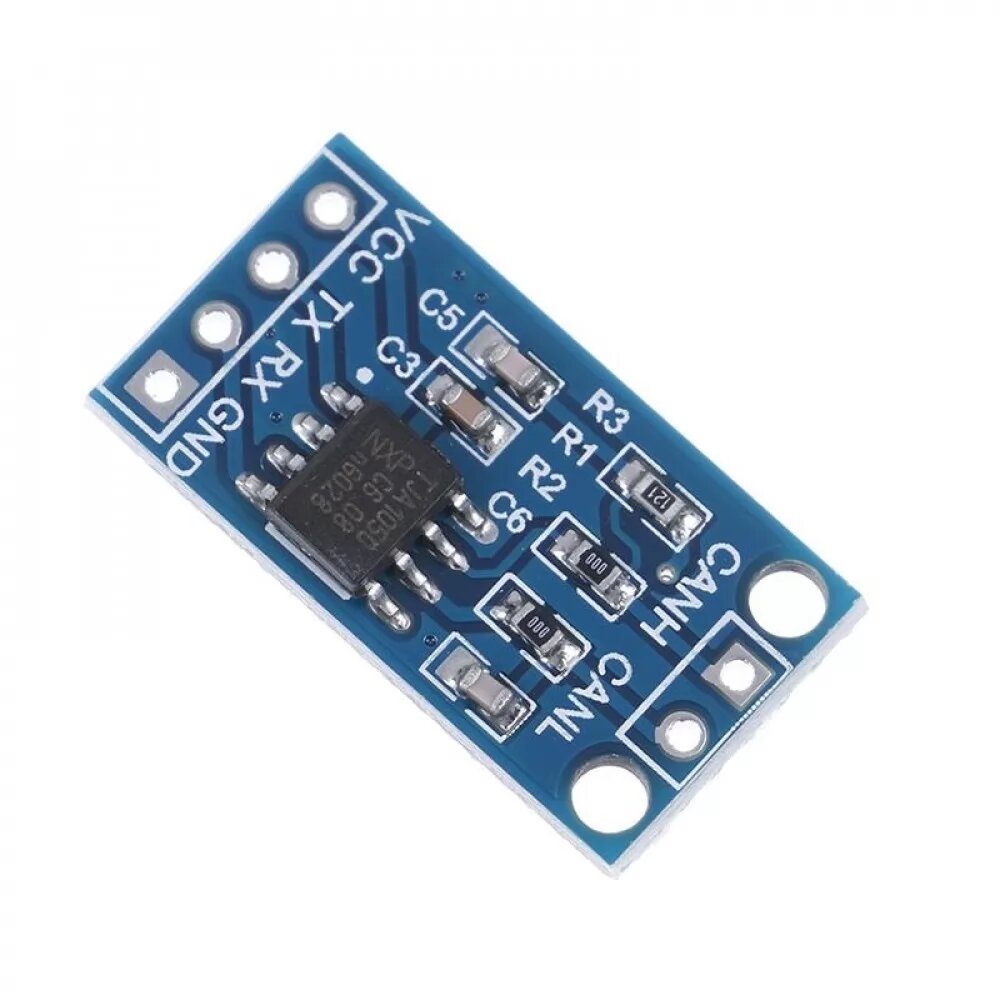
MCP2515 CAN Bus Module with TJA1050 Transceiver is an all-in-one standalone Controller Area Network (CAN) interface board combining the Microchip MCP2515 stand-alone CAN controller with the NXP TJA1050 high-speed CAN transceiver. Operating via standard 4-wire Serial Peripheral Interface (SPI), it enables microcontrollers that lack a native CAN controller (such as Arduino Uno, Mega, Nano, and Raspberry Pi) to transmit and receive standard and extended CAN 2.0B data frames at speeds up to 1 Mbps. Complete with onboard 8 MHz crystal oscillator, 120-ohm bus termination jumper, and industrial screw terminals, it is the premier choice for automotive telemetry and industrial prototyping.
Key Features:
- Complete Standalone SPI-to-CAN Solution: Combines MCP2515 protocol controller and TJA1050 physical transceiver on a single compact board.
- High-Speed 10MHz SPI Interface: Effortlessly interfaces with any microcontroller using standard 4-wire SPI communication.
- Full CAN 2.0B Specification Compliance: Supports standard (11-bit) and extended (29-bit) message identifiers at speeds up to 1.0 Mbps.
- Hardware Message Filtering & Buffering: Features two receive buffers with prioritized message storage and six 29-bit acceptance filters.
- Onboard 120-Ohm Termination Jumper: Built-in impedance termination resistor can be enabled or disabled via a simple 2-pin jumper.
Technical Specifications:
- Operating Supply Voltage: 5.0 V DC ±5%
- Operating Current: Approx. 5 mA (Standby) / up to 50 mA (Active CAN bus transmission)
- CAN Protocol Support: CAN Version 2.0B Active (11-bit standard and 29-bit extended frames)
- Maximum Communication Speed: Up to 1.0 Mbps
- Oscillator Frequency: Onboard 8.0 MHz crystal oscillator
- SPI Clock Frequency: Up to 10 MHz
- Operating Temperature Range: -40°C to +85°C (Industrial grade)
Mechanical Specifications:
- PCB Substrate: High-density double-sided FR-4 PCB with blue solder mask and white component legend
- CAN Connection: 2-position 3.81 mm pitch screw terminal block (CANH, CANL)
- Host Interface: 7-pin standard 2.54 mm pitch male pin header
- Mounting: 4 × M3 screw mounting holes for rigid chassis attachment
- Net Weight: Approx. 11.2 g
Dimensions:
- Board Length: 44.0 mm
- Board Width: 28.0 mm
- Total Height: 14.5 mm (including screw terminal block)
- Header Pin Pitch: Standard 2.54 mm (0.1 inch)
Pinout and Wiring:
- VCC: 5V DC power supply input.
- GND: Circuit ground reference (0V / GND).
- CS: Active-LOW SPI Chip Select pin (connect to MCU GPIO CS).
- SO (MISO): SPI Slave Out data line (connect to MCU MISO).
- SI (MOSI): SPI Slave In data line (connect to MCU MOSI).
- SCK: SPI Serial Clock input (connect to MCU SCK).
- INT: Active-LOW hardware interrupt output (connect to MCU external interrupt).
- CANH / CANL: Differential CAN bus terminal block connections.
Datasheet Reference:
- Microchip MCP2515 Stand-Alone CAN Controller with SPI Interface Datasheet and Arduino mcp_can Library Guide.
Commonly Used in:
- Arduino OBD-II vehicle diagnostic scanners and live vehicle telemetry displays.
- Industrial automation CANopen and DeviceNet machinery monitoring.
- Robotics distributed CAN communication networks and mobile rovers.
- Automotive bench testing, ECU spoofing, and CAN bus security research.
Applications:
- Reading real-time vehicle RPM, speed, coolant temperature, and diagnostic trouble codes (DTCs) from OBD-II.
- Interfacing an Arduino Uno to an electric vehicle (EV) battery management system (BMS).
- Building a multi-node sensor telemetry network across industrial machinery.
- Capturing and logging vehicular CAN bus traffic to an SD card.
Equivalent Models:
- TJA1050 CAN Controller Bus Driver Interface Module
- SN65HVD230 Bus Transceiver Communication Module
- CJMCU-1051 TJA1051 CAN BUS Transceiver Module
Package Includes:
- 1 × MCP2515 CAN Bus Module with TJA1050 Transceiver






Reviews
No reviews yet. Be the first to share your experience!