


Nano I/O Shield V1.0 Sensor Expansion Board for Arduino Nano V3.0 is a plug-and-play sensor and servo carrier board engineered for Arduino Nano V3.0 (and Nano-compatible RP2040 / LGT8F328P) modules. Furthermore, it breaks out all 14 digital pins (`D0–D13`) and 8 analog pins (`A0–A7`) into standardized 3-pin `GND / VCC / Signal` (GVS) male headers alongside a 5.5mm × 2.1mm DC barrel jack and an onboard 3.3V AMS1117 voltage regulator. Therefore, makers can connect up to 22 three-wire sensors, hobby servos, and I2C modules directly to an Arduino Nano without a breadboard.
Key Features:
- Full 3-Pin GVS Sensor & Servo Breakout: Provides dedicated `GND` and `5V VCC` pins right next to every digital (`D0–D13`) and analog (`A0–A7`) signal pin for instant 3-wire module connection.
- Onboard DC Barrel Jack & 3.3V LDO Regulator: Accepts 7V–12V DC external power via a standard 5.5mm × 2.1mm barrel jack and regulates an independent 3.3V rail (up to 500mA) for 3.3V peripherals.
- Dedicated 4-Pin I2C & Serial Header Banks: Exposes `GND/VCC/SDA/SCL` and `GND/VCC/RX/TX` pin groups for plug-and-play OLED displays, RTC modules, and Bluetooth transceivers.
- Bonus UNO-Compatible Outer Shield Footprint: Also includes outer 2.54mm pad rows matching the classic Arduino UNO R3 shield spacing.
- Accessible Reset Button & Power LED: Top-mounted tactile reset switch and power indicator LED remain easily accessible even when all sensor headers are populated.
Technical Specifications:
- Compatible Host Boards: Arduino Nano V3.0 / V2.x (30-Pin DIP Layout, 2.54mm Pitch)
- External Input Voltage (DC Jack): 7.0V to 12.0V DC
- Digital GVS Headers: 14 × 3-Pin Male Headers (`D0–D13` paired with `5V` and `GND`)
- Analog GVS Headers: 8 × 3-Pin Male Headers (`A0–A7` paired with `5V` and `GND`)
- Auxiliary Power Output Headers: 6 × `3.3V / GND` Pins (Driven by Onboard AMS1117-3.3 Regulator)
- Communication Banks: 4-Pin I2C (`SDA/SCL`) + 4-Pin UART (`TX/RX`)
Mechanical Specifications:
- PCB Substrate: Double-Sided Blue/Red FR-4 Fiberglass PCB with Color-Coded or Clearly Labeled GVS Rows
- Nano Socket: 2 × 15-Pin 2.54mm Pitch Female Header Receptacles
- Mounting Holes: 4 × M3 Mounting Holes (Standard UNO R3 Spacing)
Dimensions:
- Length: 57.0 mm
- Width: 54.0 mm
- Height: 14.0 mm
- Weight: ≈ 23 g
Pinout and Wiring:
- Nano Insertion Orientation: Plug the Arduino Nano into the two 15-pin female sockets with the Nano’s USB port facing the same side as the shield’s DC barrel jack (matching `D13` and `VIN` labels).
- 3-Pin GVS Rows (`G – V – S`): The outer row is `GND` (Black/Brown wire), the middle row is `VCC / 5V` (Red wire), and the inner row is `Signal` (Yellow/White/Orange wire).
- I2C Header: Connects `SDA (A4)`, `SCL (A5)`, `5V`, and `GND` to I2C LCDs or sensors.
- Engineering Precaution: Always verify the `VIN` and `D13` pin markings before powering up; inserting the Arduino Nano rotated 180 degrees will route 7V–12V barrel-jack voltage into the wrong Nano pins and damage the board.
Datasheet Reference:
Commonly Used in:
- Multi-Servo Biped/Quadruped Robots and Robotic Arm Controllers
- 37-in-1 KY-Series Sensor Prototyping without Solderless Breadboards
- Classroom Robotics & STEM Automated Greenhouse Projects
Applications:
- Multi-Servo Robotics: Plugs up to 12 standard 3-pin hobby servo connectors (`GND/5V/Signal`) directly into `D2–D13`.
- Clean Sensor Hub Wiring: Connects ultrasonic sensors, IR obstacle sensors, soil moisture probes, and relay modules using 3-wire female-to-female cables.
- UNO Shield Adapter for Nano: Allows an Arduino Nano to interface with standard UNO-spaced daughterboards via the outer pad rows.
Equivalent Models:
- Arduino Nano V3.0 Prototype / IO Shield: Similar Nano GVS expansion carrier board.
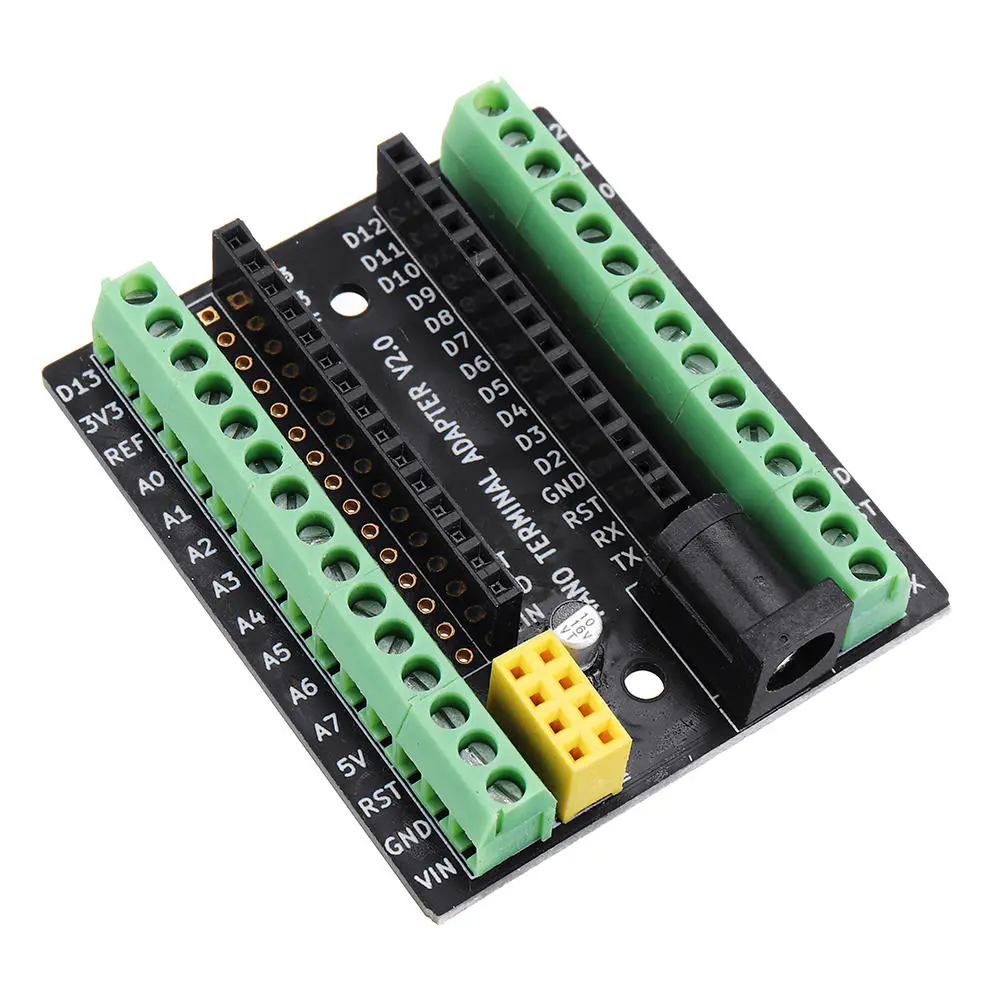
- nRF24L01+ & Screw Terminal Nano Expansion Shield: Adds perimeter screw terminals and an 8-pin nRF24L01+ socket alongside the 3-pin GVS headers.
- Arduino UNO Sensor Shield V5.0: Equivalent 3-pin GVS sensor expansion shield designed to stack atop a full-size Arduino UNO R3.
Package Includes:
- 1 × Nano I/O Shield V1.0 Sensor Expansion Board for Arduino Nano V3.0






Reviews
No reviews yet. Be the first to share your experience!