
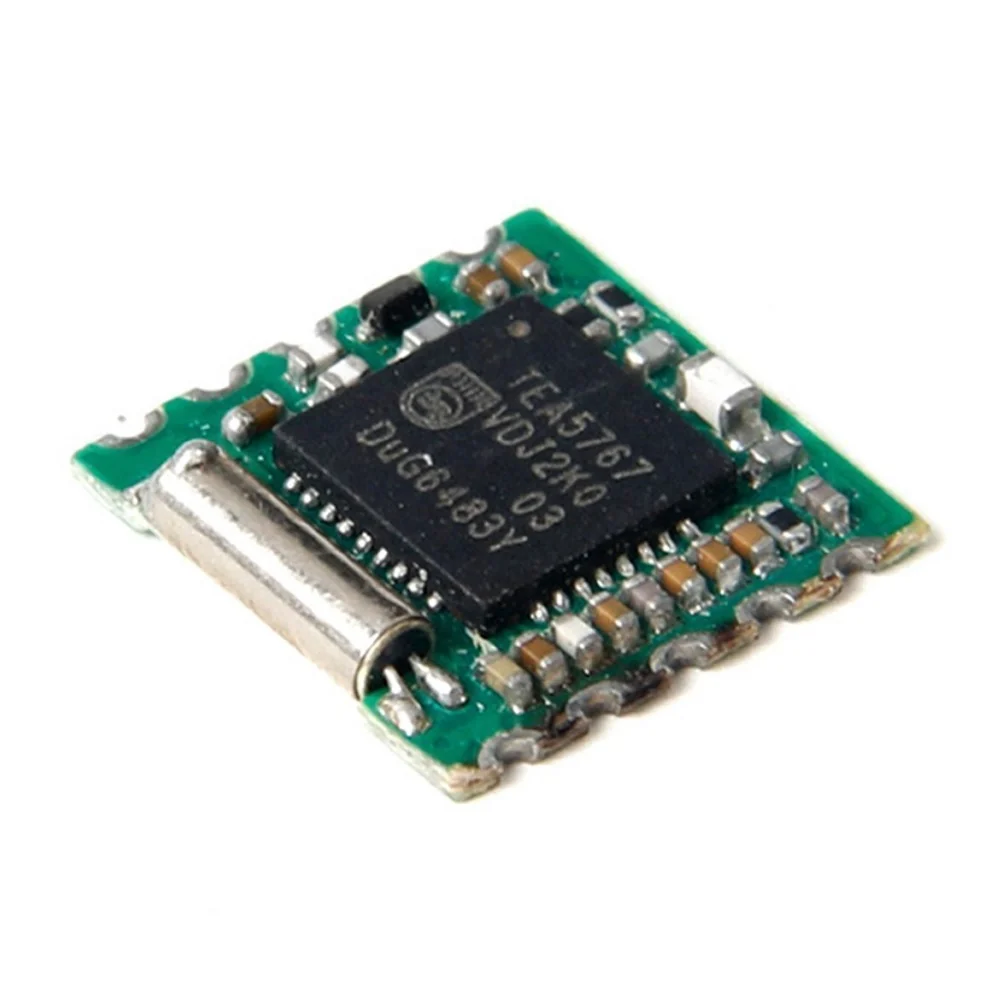
TEA5767 Radio Module FM Radio Module is a high-sensitivity, single-chip electronically tuned FM stereo receiver designed for microcontrollers and DIY audio electronics. This compact board integrates the Philips/NXP TEA5767 IC, which completely eliminates external intermediate frequency (IF) tuning circuits. Consequently, it enables rapid prototyping and seamless I2C digital control with platforms like Arduino, ESP32, and Raspberry Pi. Furthermore, the onboard 3.5 mm audio jack allows direct output to headphones or external amplifiers. Therefore, developers can easily build intelligent, programmable broadcast receivers with minimal external hardware components.
Key Features:
- High Sensitivity: Integrates low-noise RF input amplifiers to achieve exceptional signal clarity across wide FM bands.
- Digital I2C Interface: Communicates via standard two-wire I2C protocol, allowing easy frequency tuning and status feedback.
- Integrated Tuning Circuit: Features automatic gain control (AGC) and software-controlled autonomous search tuning.
- Audio Output: Includes an onboard 3.5 mm stereo jack that connects directly to headphones or active speaker modules.
- Broad Reception Range: Covers global FM bands from 76 MHz to 108 MHz, including the Japanese and standard US/EU bands.
Technical Specifications:
- Operating Voltage: 5.0 V DC (onboard regulator supports 3.3 V to 5 V input)
- Frequency Range: 76.0 MHz – 108.0 MHz
- Communication Interface: I2C Bus (Address: 0x60)
- Current Consumption: ≈ 15 mA (Operating)
- Intermediate Frequency: 225 kHz
- Crystal Oscillator: 32.768 kHz
- Audio Output Impedance: ≈ 32 Ω
- Signal-to-Noise Ratio (SNR): ≥ 54 dB
Mechanical Specifications:
- PCB Material: FR-4 Glass Epoxy
- Header Pitch: Standard 2.54 mm (0.1 in)
- Antenna Connector: Onboard 3.5 mm jack / Solder pad for external wire antenna
- Mounting: Dual breadboard-friendly pin rows
Dimensions:
- Length: ≈ 31.0 mm
- Width: ≈ 30.0 mm
- Height: ≈ 12.0 mm (including 3.5 mm audio jack)
- Weight: ≈ 6.5 g
Pinout and Wiring:
- VCC: 5V power supply input from the microcontroller.
- GND: Ground connection.
- SDA: I2C Serial Data line for bidirectional communication.
- SCL: I2C Serial Clock line for timing synchronization.
- ANT: External antenna connection point to improve signal reception; however, the 3.5 mm headphone ground wire can also function as an antenna.
Datasheet Reference:
Commonly Used in:
- Arduino Projects: Building custom digital FM stereo receivers with LCD or OLED frequency displays.
- Embedded Audio Systems: Adding broadcast radio reception to Raspberry Pi and ESP32 smart home systems.
- Educational Kits: Demonstrating digital tuning, RF principles, and I2C communication in university electronics labs.
Applications:
- Smart Alarm Clocks: Powering automated wake-up radios that tune into live morning broadcasts.
- Portable Media Players: Integrating supplementary FM radio capabilities into custom audio boomboxes.
- Emergency Radios: Providing autonomous local radio reception for remote field equipment and battery-operated monitors.
Equivalent Models:
- RDA5807M: A pin-compatible and software-compatible FM tuner IC with integrated RDS/RBDS decoding support.
- Si4703: A Silicon Labs FM tuner breakout board featuring built-in RDS decoding and digital volume control.
- TEA5768HL: A closely related NXP FM stereo receiver IC designed for similar low-power embedded applications.
Package Includes:
- 1 x TEA5767 Radio Module FM Radio Module



Reviews
No reviews yet. Be the first to share your experience!