

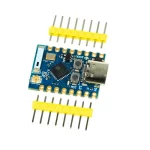
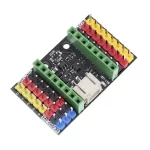
ESP32-C3 Supermini WIFI Bluetooth Development Board is an ultra-compact, high-performance solution that leverages the RISC-V architecture for modern IoT applications. This board features the powerful Espressif ESP32-C3 chip, integrating both Wi-Fi and Bluetooth 5 (LE) radio protocols onto a tiny form factor. Consequently, this Supermini version is highly effective for projects demanding minimal size and ultra-low power consumption. Furthermore, its small footprint and rich peripheral set, which includes multiple GPIOs, ADC, and serial interfaces, enable developers to build complex, battery-powered devices such as wearables, smart sensors, and secure home automation modules. Therefore, select this board when space and power efficiency are absolutely critical design constraints for your wireless embedded system.
Key Features:
- Integrated Wireless Connectivity: Supports IEEE 802.11 b/g/n Wi-Fi (2.4 GHz) and Bluetooth 5 (LE), providing robust dual-mode wireless communication.
- RISC-V Single-Core CPU: Utilizes a 32-bit RISC-V single-core processor that clocks up to 160 MHz, delivering excellent processing power for IoT tasks.
- Ultra-Low Power Consumption: Engineered for efficiency, featuring a Deep Sleep power consumption as low as ≈ 43 µA, significantly extending battery life.
- Rich Memory Resources: The module integrates 400 KB SRAM, 384 KB ROM, and a built-in 4 MB SPI flash for ample code and data storage.
- Enhanced Security: Features hardware encryption accelerators for AES-128/256, Hashing, RSA, and Secure Boot, fortifying your application against threats.
- USB Type-C Interface: Incorporates a USB-C port for both power supply and simplified programming/debugging via the built-in USB-to-UART bridge.
Technical Specifications:
- Microcontroller: ESP32-C3FN4 (32-bit RISC-V single-core)
- Clock Frequency: Up to 160 MHz
- SRAM / ROM: 400 KB SRAM / 384 KB ROM
- Flash Memory: 4 MB SPI Flash
- Wireless Protocols: Wi-Fi 802.11 b/g/n, Bluetooth 5 (LE)
- GPIO Pins: 11 accessible programmable GPIOs
- Analog Inputs: 2 × 12-bit SAR ADC, up to 6 channels
- Interfaces Supported: 2×UART, 1×I2C, 1×SPI, 6×PWM channels
Mechanical Specifications:
- Form Factor: Super Mini Development Board
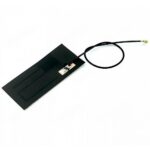
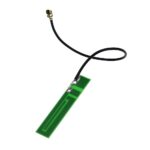
- Antenna Type: On-board PCB Antenna (or compatible with external antenna)
- Mounting: Designed for breadboard use or permanent soldering
- Connectivity Port: USB Type-C
Dimensions:
- Board Length: 22.52 mm (≈ 0.89 in)
- Board Width: 18.00 mm (≈ 0.71 in)
- Pin Pitch: 2.54 mm (Standard breadboard pitch)
- Weight: Typically less than 2 g (Ultra-lightweight)
Pinout and Wiring:
- 5V Pin: Use this pin as the 5V power input (3.3V to 6V supply range supported) or 5V output when powered via USB-C.
- 3V3 Pin: Provides regulated 3.3V output from the onboard regulator; alternatively, you can use it as a 3.3V input source.
- GPIO Pins (IO0-IO9): These pins handle digital I/O, PWM, and communication interfaces. Specifically, IO0-IO3 handle ADC inputs.
- GND Pin: Connect this pin to the common ground of your circuit.
- Boot/RST Buttons: Use the BOOT button (GPIO9) and the RST button to manually control boot modes for programming.
Datasheet Reference:
Commonly Used in:
- Wearable Technology: Its small size and low power draw make it ideal for wrist devices and smart jewelry.
- Wireless Sensors: Providing both Wi-Fi and BLE connectivity for environmental, temperature, and motion sensing nodes.
- Smart Home Devices: Used in hidden controllers, light switches, and battery-operated smart locks.
Applications:
- Bluetooth Mesh Networking: Establishing low-power, wide-area communication networks using its robust Bluetooth 5.0 capabilities.
- Prototyping IoT Gadgets: Since it supports both Arduino IDE and ESP-IDF, developers quickly prototype custom wireless gadgets.
- Secure Edge Computing: Indeed, the hardware security features allow secure data processing and communication at the network’s edge.
Equivalent Models:
- ESP32-C3 DevKitM-1: Espressif’s standard reference board, which shares the same SoC but uses a larger form factor.
- Seeed Studio XIAO ESP32C3: Another ultra-small development board, often considered a direct competitor in the mini/micro form factor category.
- WeMos D1 Mini C3: Essentially, this is a similar C3-based mini board, often with a different pin layout or peripheral configuration.
Package Includes:
- 1 x ESP32-C3 Supermini WIFI Bluetooth Development Board


Reviews
No reviews yet. Be the first to share your experience!