
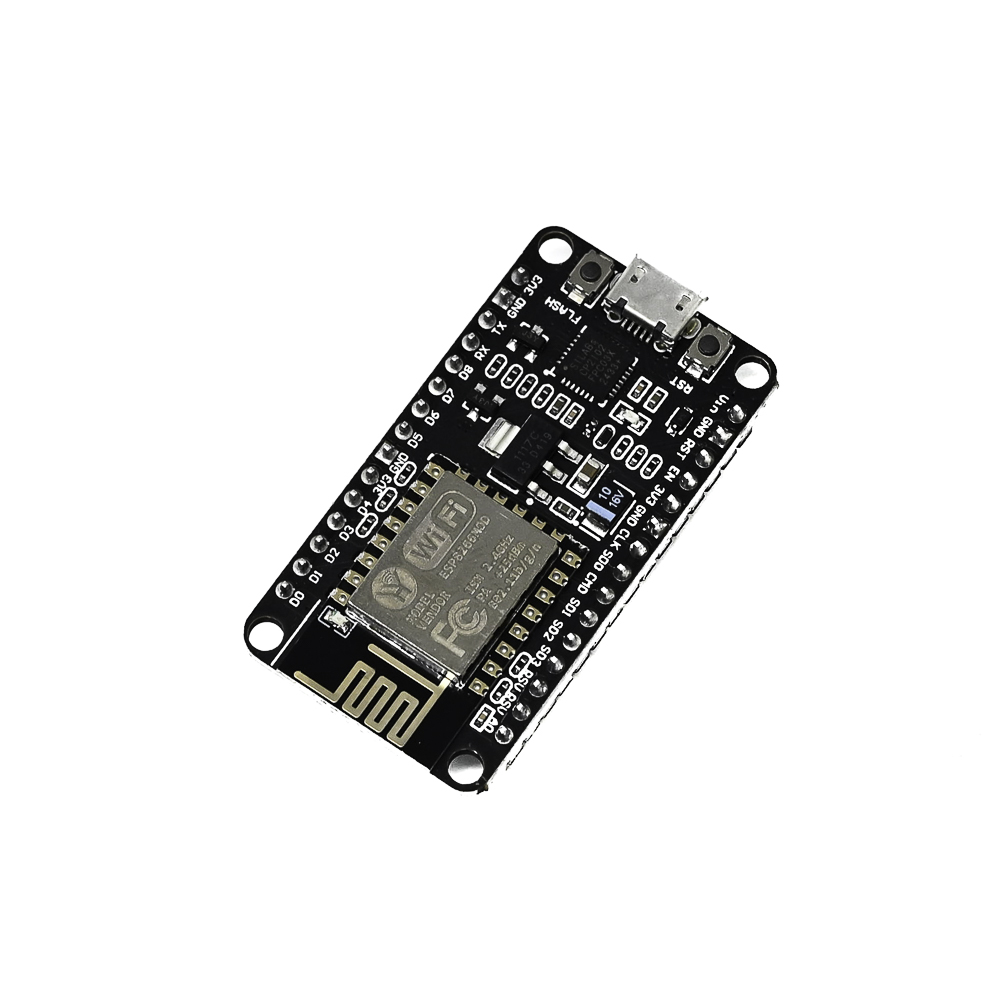
NodeMCU V2 ESP8266 CP2102 Amica Wi-Fi IoT Development Board is the official slim-profile open-source IoT development platform based on the Espressif ESP-12E (ESP8266EX) Wi-Fi module. Featuring the high-stability Silicon Labs CP2102 USB-to-UART bridge, a narrow 0.9-inch breadboard-friendly footprint that leaves a full row of tie-points accessible on each side, onboard 3.3V LDO regulation, and full Arduino IDE / NodeMCU Lua support, the Amica board is the premier standard for connected IoT development.
Key Features
- Slim Breadboard-Friendly Footprint: Amica V2 form-factor spans only 0.9 inches, leaving accessible breadboard rows on standard solderless breadboards.
- Silicon Labs CP2102 USB Bridge: Rock-solid, industrial-grade USB-to-UART communication with automatic RTS/DTR flashing circuit.
- High-Performance ESP8266EX Core: 32-bit Tensilica L106 RISC processor running up to 160 MHz with 4MB SPI Flash memory.
- Integrated 2.4 GHz 802.11 b/g/n Wi-Fi: Features complete TCP/IP protocol stack, onboard PCB antenna, and FCC/CE certification.
- Integrated 3.3V Power Regulation: Robust onboard LDO regulator supports 5V Micro-USB or external DC input up to 10V.
- Comprehensive Software Support: Fully supported in Arduino IDE, ESP-IDF, MicroPython, PlatformIO, and Lua script interpreter.
Technical Specifications
- SoC Module: ESP8266 ESP-12E (Tensilica 32-bit LX106 @ 80/160 MHz)
- Flash Memory: 4MB (32Mbit) external SPI Flash
- USB-to-UART Controller: Silicon Labs CP2102
- Operating Voltage: 5V DC via Micro-USB or 4.5V–10V DC via VIN pin
- Regulated Output: 3.3V DC (up to 600 mA)
- Wi-Fi Standard: IEEE 802.11 b/g/n (2.412 GHz – 2.484 GHz)
- Antenna: High-efficiency onboard PCB trace antenna
- Digital I/O Pins: 11 GPIO pins (all support PWM, I2C, SPI except D0)
- Analog Input: 1 × 10-bit ADC channel (A0, 0V to 3.3V through internal voltage divider)
Mechanical Specifications
- Form Factor: 30-pin dual in-line breadboard layout (0.9-inch row spacing)
- USB Connector: Standard Micro-USB Type-B
- Buttons: Reset (RST) and Flash (FLASH) tactile buttons
- Weight: 7.0 g
Dimensions
- Length: 48.3 mm
- Width: 25.4 mm
- Height: 13.0 mm
Pinout and Wiring
- VIN: External 5V to 10V DC power input
- 3V3: 3.3V regulated power rail (power external sensors)
- GND: System ground connections (multiple pins)
- A0 (ADC0): 10-bit analog-to-digital input channel
- D0 (GPIO16): Connect to RST for deep sleep wake-up
- D1 (GPIO5) / D2 (GPIO4): Hardware I2C bus (SCL and SDA)
- D5–D8 (GPIO14, 12, 13, 15): Hardware SPI bus (SCK, MISO, MOSI, SS)
- TX / RX (GPIO1 / GPIO3): Primary hardware UART serial lines
Datasheet Reference
- Refer to the NodeMCU Amica V2 Schematic and Espressif ESP8266EX Technical Reference Manual for detailed GPIO multiplexing tables and CP2102 driver installation.
Commonly Used in
- Home automation hubs, smart plugs, and wireless light switches
- Cloud IoT temperature, humidity, and environmental data loggers
- STEM classroom computer science and IoT engineering courses
- Robotics wireless remote controllers and telemetry
Applications
- ESP8266 Wi-Fi sensor networks communicating via MQTT or HTTP
- Blynk, Home Assistant, and ESPHome smart home integration
- Smart garden automated soil irrigation systems
- Industrial telemetry gateways
Equivalent Models
- NodeMCU ESP8266 V3 CH340G (Lolin wide version, Category 622, PID 901)
- WeMos D1 Mini ESP8266 Development Board
- ESP32 NodeMCU Development Board (dual-core upgrade)
- Adafruit Feather HUZZAH ESP8266
Package Includes
- 1 × NodeMCU V2 ESP8266 CP2102 Amica Wi-Fi IoT Development Board




Best quality and best price
Fast delivery. got in 6 Hrs only in vadodara.. best service.