
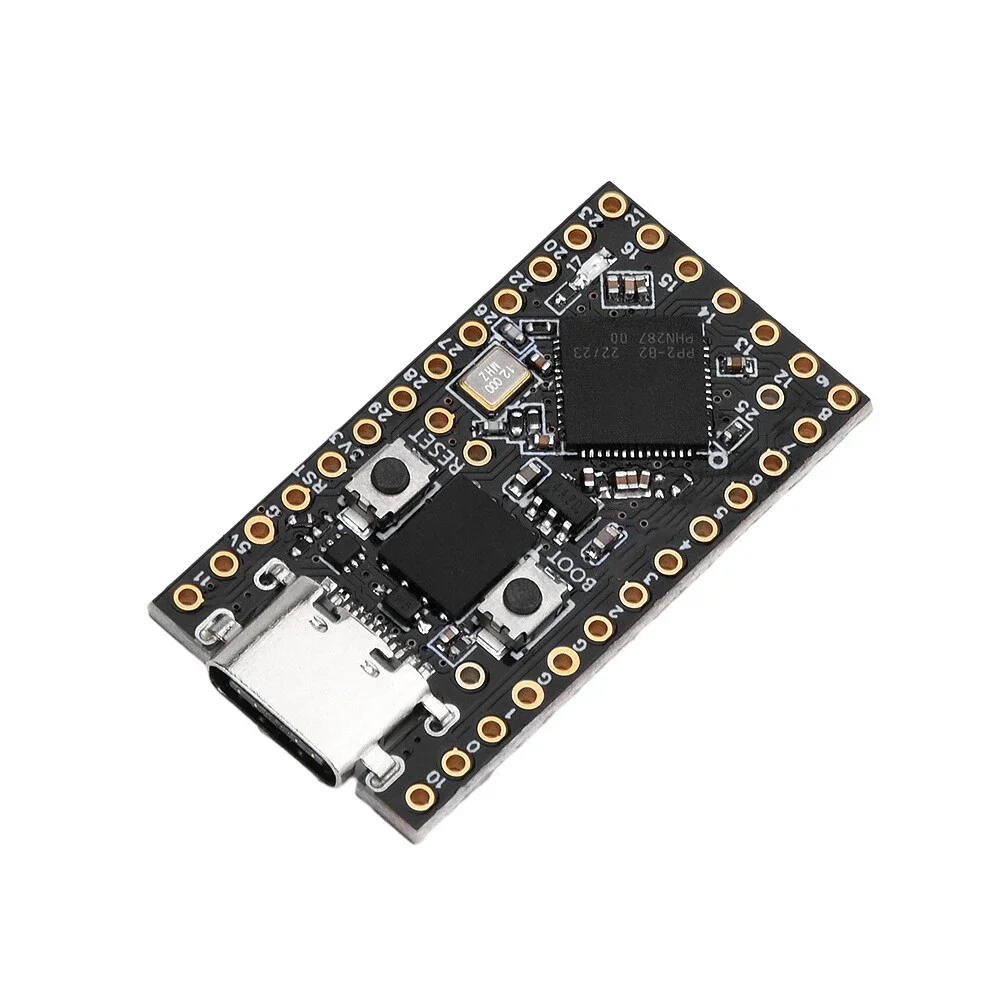
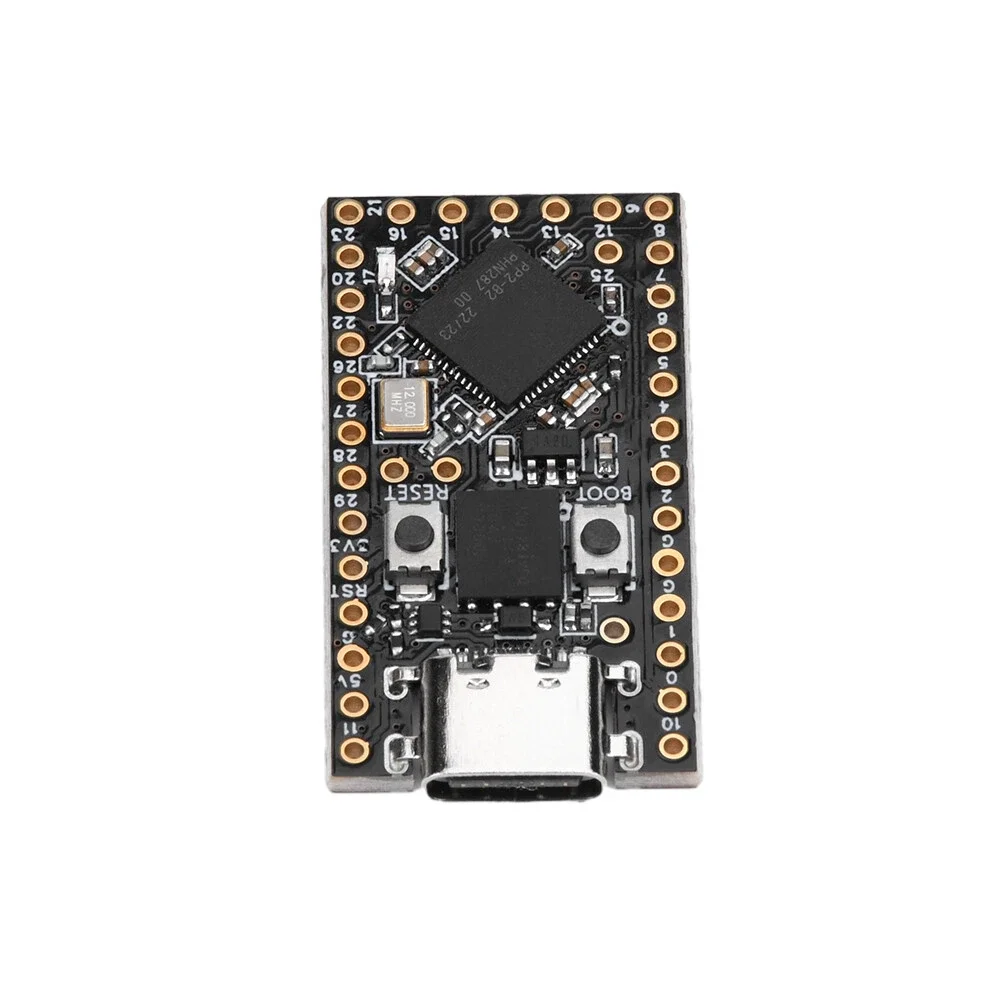
RP2040 4MB Dual-Core Pro Micro Development Board is a compact microcontroller development board combining the Raspberry Pi RP2040 dual-core ARM Cortex-M0+ processor with the industry-standard SparkFun Pro Micro 24-pin footprint. Furthermore, it integrates 4MB (32Mbit) of onboard QSPI NOR Flash, a reversible USB Type-C connector, an addressable WS2812 RGB status LED, and hardware BOOTSEL/RESET tactile buttons. Consequently, firmware developers building QMK/VIAL custom mechanical keyboards, USB HID peripherals, and compact MicroPython embedded nodes can upgrade legacy ATmega32U4 Pro Micro sockets directly to 32-bit dual-core 133 MHz performance.
Key Features:
- Dual-Core ARM Cortex-M0+ Silicon: Powered by the official Raspberry Pi RP2040 MCU clocked at up to 133 MHz with 264KB multi-bank internal SRAM.
- Expanded 4MB Onboard QSPI Flash: Doubles the flash storage of a standard 2MB Pico for storing CircuitPython libraries, QMK keymaps, and OLED fonts.
- Drop-In Pro Micro Footprint: Matches the classic 12+12 pin 2.54mmDIP layout of the ATmega32U4 Pro Micro while adding bottom solder pads for extra GPIOs.
- USB Type-C & UF2 Drag-and-Drop Bootloader: Native USB 1.1 device/host controller flashes firmware via mass-storage drag-and-drop without external programmers.
- Onboard WS2812B Addressable RGB LED: Includes a user-programmable NeoPixel status LED plus dedicated hardware RESET and BOOT tactile switches.
Technical Specifications:
- Microcontroller: Raspberry Pi RP2040 Dual-Core ARM Cortex-M0+ (Up to 133 MHz)
- On-Chip SRAM: 264 KB Across 6 Independent Banks
- External Flash Memory: 4 MB (32 Mbit) Winbond W25Q32 QSPI NOR Flash
- Operating Logic Voltage: 3.3V DC (Powered via 5V USB Type-C or RAW 3.6V–5.5V Pin)
- Onboard Voltage Regulator: 3.3V Low-Dropout (LDO) Regulator (Up to 500mA Output)
- GPIO & Peripherals: 20+ Multifunction 3.3V GPIOs (4 × 12-Bit ADC, 2 × UART, 2 × SPI, 2 × I2C, 16 × PWM, 8 × PIO State Machines)
- USB Interface: USB Type-C Receptacle (USB 1.1 Host/Device)
- Supported Frameworks: C/C++ Pico SDK, MicroPython, CircuitPython, Arduino IDE, QMK, and KMK
Mechanical Specifications:
- PCB Construction: High-Density Double-Sided FR-4 Fiberglass PCB with Castellated and Through-Hole 2.54mm Pads
- Header Pinout Layout: Dual-Row 24-Pin (2 × 12) 2.54mm Pitch with 15.24mm (0.6 inch) Row Spacing
- Onboard Controls: SMD Tactile RESET Button and BOOTSEL Button
Dimensions:
- Length: 33.0 mm
- Width: 18.0 mm
- Height: 4.2 mm (Unpinned)
- Weight: ≈ 3.5 g
Pinout and Wiring:
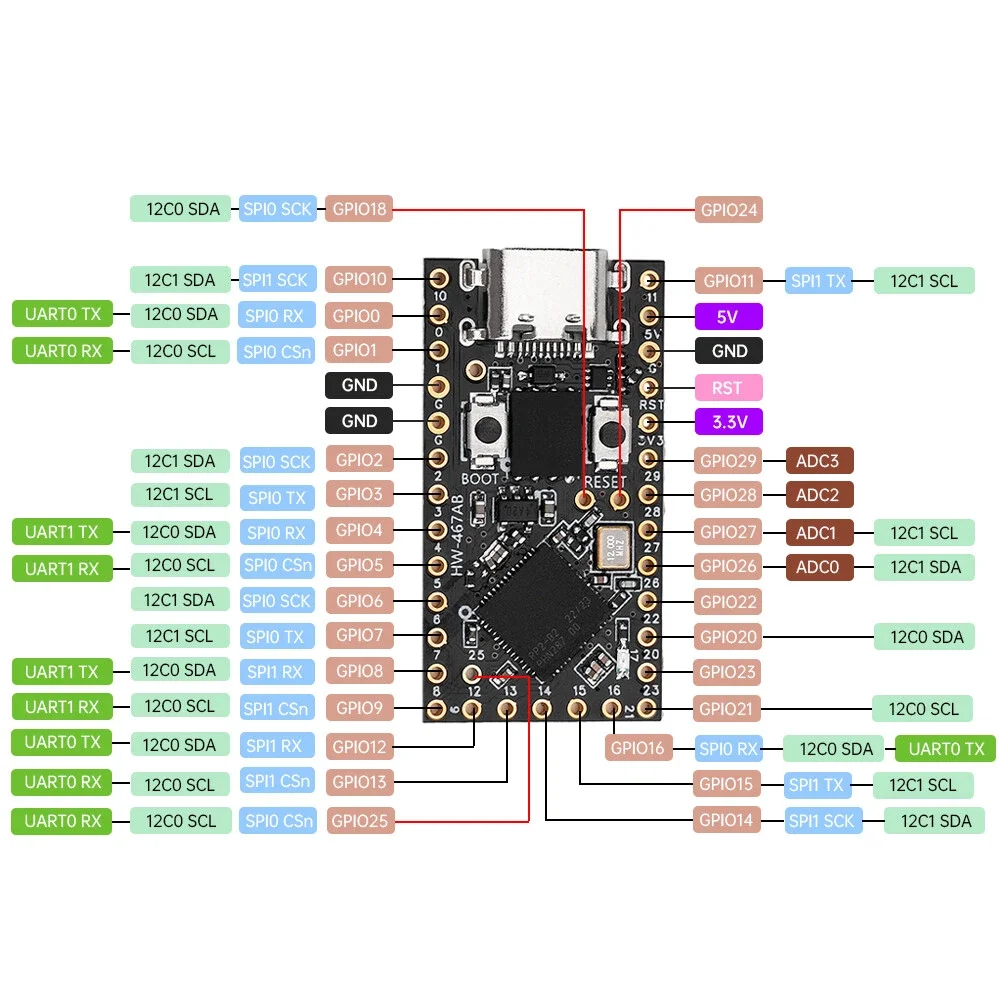
- RAW / GND / VCC (3.3V): External 5V input on RAW, common Ground on GND, and regulated 3.3V output on VCC.
- TX (GP0) & RX (GP1): Hardware UART0 transmit and receive pins on the top-left Pro Micro positions.
- GPIO2–GPIO9 & GPIO20–GPIO23: Digital I/O, I2C, SPI, and PWM channels along the two 12-pin edges.
- A0–A3 (GP26–GP29): 12-bit SAR analog-to-digital converter inputs.
- Engineering Precaution: Unlike the 5V ATmega32U4 Pro Micro, all RP2040 GPIO pins operate strictly at 3.3V logic and are NOT 5V-tolerant; therefore, power WS2812 matrices and split-keyboard TRRS lines appropriately for 3.3V signaling.
Datasheet Reference:
Commonly Used in:
- Split Ergonomic & Ortholinear QMK/VIAL/KMK Custom Mechanical Keyboards (Corne, Sofle, Lily58)
- Compact USB HID Macro Pads, Rotary Stream Decks, and Sim-Racing Button Boxes
- Space-Constrained MicroPython & CircuitPython Sensor Nodes
Applications:
- Mechanical Keyboard Upgrades: Replaces 8-bit ATmega32U4 Pro Micro boards in custom keyboard PCBs to unlock massive 4MB keymap space, RGB matrix animations, and OLED displays.
- High-Speed Protocol Emulation: Uses RP2040 Programmable I/O (PIO) state machines to generate deterministic WS2812, DPI, I2S, or CAN-bus waveforms.
- Wearable & Handheld Instrumentation: Fits into miniature 3D-printed enclosures requiring native USB-C connectivity.
Equivalent Models:
- SparkFun Pro Micro RP2040: Original Qwiic-equipped Pro Micro RP2040 board with 16MB flash, whereas this 4MB variant provides a more cost-effective drop-in footprint.
- Waveshare RP2040-Zero: 23.5×18mm stamp-sized RP2040 board with 2MB flash, although it uses a 29-pin Pico-Zero pinout instead of the 24-pin Pro Micro layout.
- ATmega32U4 Pro Micro (5V/16MHz): Legacy 8-bit AVR Pro Micro with 32KB flash and 5V logic, whereas the RP2040 Pro Micro offers 128× more flash and dual-core 133 MHz speed at 3.3V.
Package Includes:
- 1 × RP2040 4MB Dual-Core Pro Micro Development Board




Reviews
No reviews yet. Be the first to share your experience!