

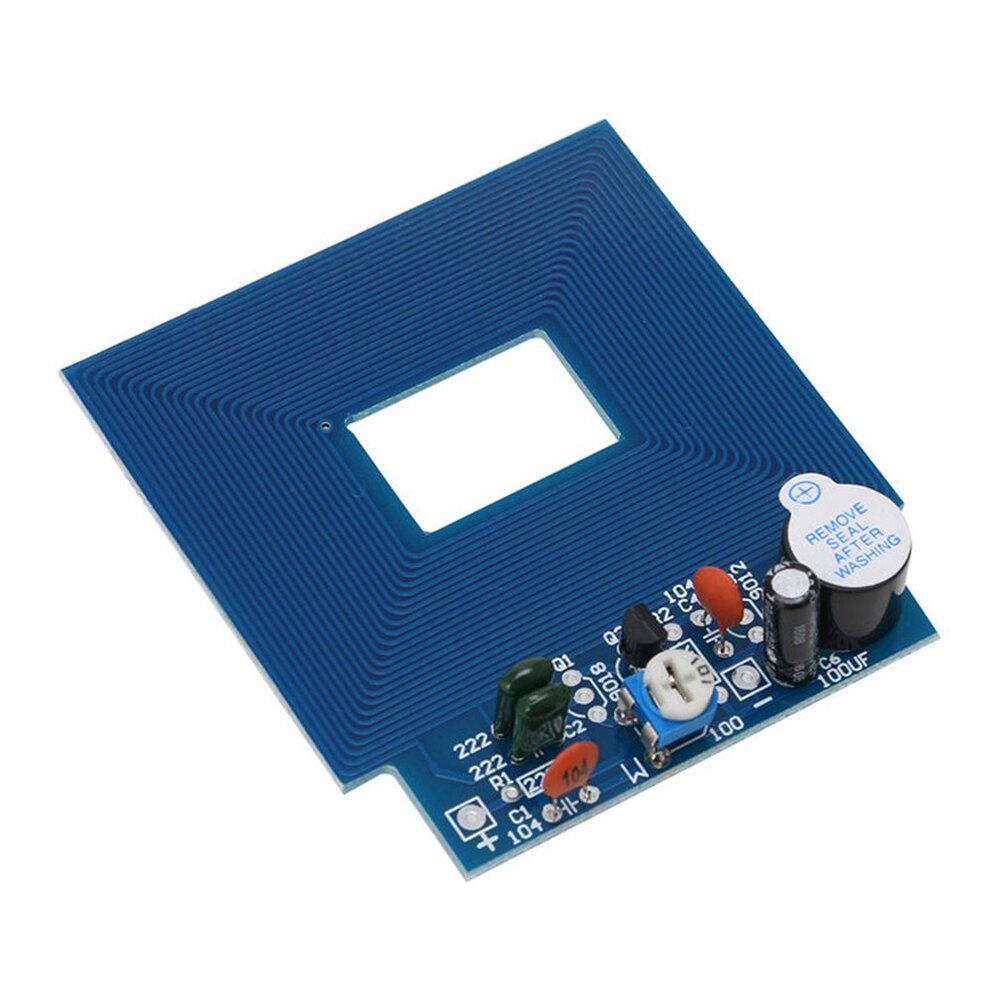
DIY Non-Contact Metal Detector Sensor Module
₹125.00
DIY Non-Contact Metal Detector Sensor Module offers an accessible and compact solution for integrating basic metal detection capabilities into hobby projects and educational electronics. This module operates on the principle of electromagnetic induction, utilizing an on-board inductor coil and oscillator circuit to detect the presence of nearby metallic objects without physical contact. Consequently, when a metal object enters the electromagnetic field, it dampens the oscillation frequency, which the detection circuit processes and reports via a digital output pin. You can easily interface this straightforward module with microcontrollers like Arduino or Raspberry Pi. Therefore, this sensor is the perfect starting point for building simple security scanners, proximity sensors, and treasure-hunting devices.
Key Features:
- Inductive Sensing Technology: Uses electromagnetic induction, a reliable non-contact method, to detect both ferrous and non-ferrous metals.
- Digital Output Signal: Provides a simple, clean digital HIGH/LOW signal indicating the presence or absence of metal, simplifying integration with digital logic systems.
- Adjustable Sensitivity: Features an on-board trimmer potentiometer, allowing users to fine-tune the detection range and sensitivity for specific applications.
- Low Power Consumption: The module operates efficiently within standard microcontroller supply voltages, making it suitable for battery-powered projects.
- Compact and Simple: Offers an integrated solution on a small PCB, eliminating the need to design complex oscillator and amplification circuits from scratch.
Technical Specifications:
- Detection Principle: Electromagnetic Induction (LC Oscillator damping)
- Operating Voltage (VCC): 3.3 V to 5 V DC
- Detection Range: Typically 1 cm to 6 cm (Dependent on coil size, sensitivity setting, and metal mass)
- Output Type: Digital (Active Low or Active High, specific to board design, usually HIGH when metal is detected)
- Detection Frequency: ≈ 1 MHz (Varies based on component values and metal influence)
- Operating Temperature Range: −10°C to +50°C
Mechanical Specifications:
- Main Component: LC Oscillator Circuit with Comparator/Detection IC (often uses components like LM393 or specialized ICs)
- Sensing Element: Integrated PCB Coil (Inductor)
- Mounting: Fixed screw holes for easy integration into project casings.
- Adjustability: Single turn potentiometer for sensitivity adjustment.
Dimensions:
- Module Board Size: ≈ 35 mm x 30 mm
- Sensing Coil Diameter: ≈ 20 mm
- Header Type: 3-pin standard header (2.54 mm pitch)
- Weight: ≈ 5 g (Extremely light)
Pinout and Wiring:
- VCC: Connect to the positive power supply rail (3.3V or 5V).
- GND: Connect to the circuit ground reference (0V).
- OUT: Digital Output Pin. Connect this directly to a digital input pin on your microcontroller (e.g., Arduino pin).
- Usage Note: The output typically goes HIGH when metal is detected. Always consult the specific module’s silkscreen or datasheet to confirm the HIGH/LOW state behavior.
Datasheet Reference:
- Download KY-024 Metal Detector Module Reference (Common Equivalent)
Commonly Used in:
- Educational Electronics Kits: Frequently included in starter kits for teaching inductive sensing principles.
- Hobbyist Robotics: Used for simple navigation, boundary detection, or object identification tasks.
- Security Prototypes: Building basic proximity or access control systems that detect metal objects.
Applications:
- Proximity Sensing: Detecting objects in non-contact scenarios, particularly where inductive proximity switches are required.
- DIY Security Checkpoints: Creating simple, low-cost handheld or fixed metal scanners.
- Hidden Object Detection: Finding nails, screws, or wiring concealed within drywall or wood structures.
- Level Sensing: Determining the presence of metallic components within non-metallic containers.
Equivalent Models:
- KY-024 Module: A very common and functionally identical 3-pin metal sensor module, often used as a direct alternative.
- Inductive Proximity Sensor (Small NPN/PNP): Industrial-grade sensors like LJ12A3-4-Z/BX, however, they generally offer a much higher detection range and dedicated power requirements.
- DIY LC Circuit Kits: Components to build the oscillator and comparator circuit manually, although this module provides a pre-assembled convenience.
Package Includes:
- 1 x DIY Non-Contact Metal Detector Sensor Module
Additional information
| Weight | 20 g |
|---|---|
| Dimensions | 65 × 60 × 5 mm |


Reviews
There are no reviews yet.