
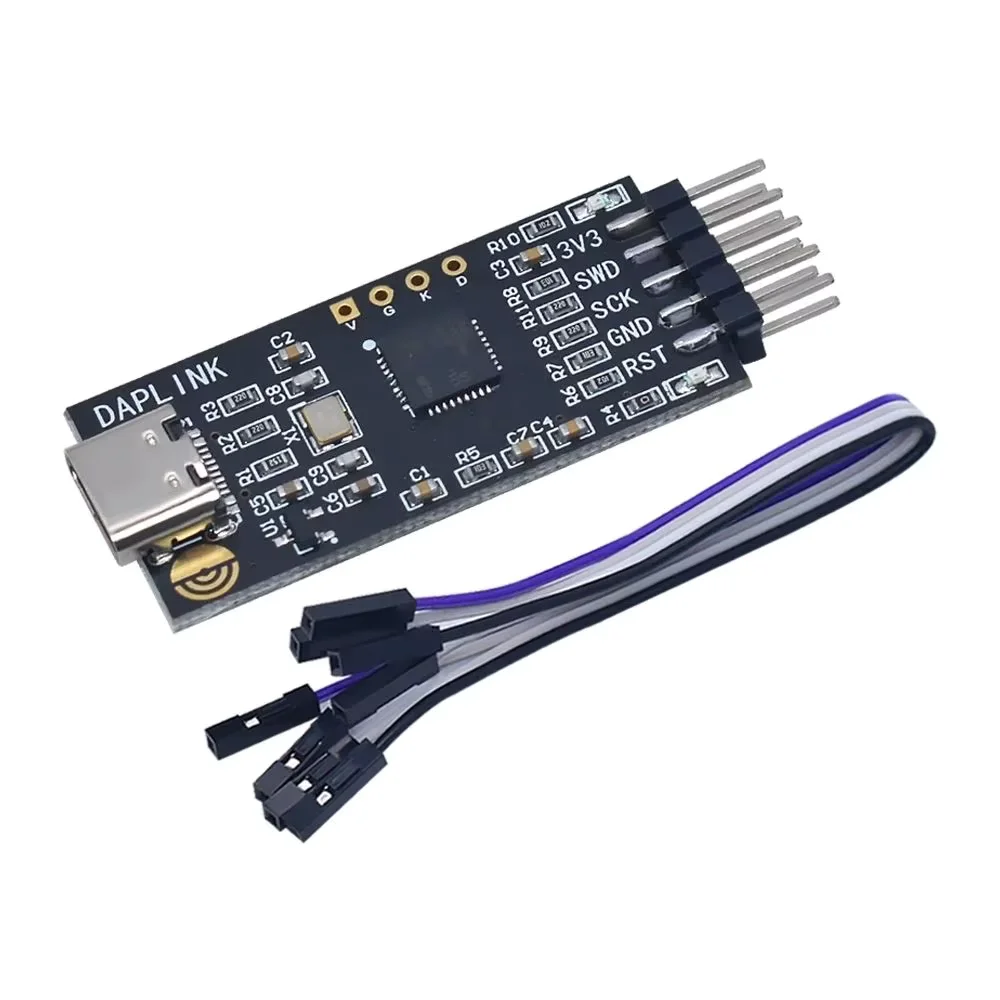
DAPLINK USB Programmer and Debugger for ARM Development Module
₹499.00
DAPLINK USB Programmer and Debugger for ARM Development Module is an essential, high-speed development tool that provides seamless programming and debugging capabilities for a wide range of ARM Cortex microcontrollers. Based on the widely adopted CMSIS-DAP (Cortex Microcontroller Software Interface Standard – Debug Access Port) protocol, this module offers a robust, drag-and-drop programming interface, appearing as a standard USB mass storage device upon connection. Consequently, developers can flash firmware onto target boards simply by copying the binary file, eliminating complex toolchain setups for basic programming. Furthermore, its full debug functionality allows for single-stepping, breakpoint setting, and memory examination using popular IDEs like Keil MDK, IAR EWARM, and GCC-based tools. Therefore, the DAPLINK module streamlines the development cycle, making it an indispensable asset for embedded engineers working with ARM architecture.
Key Features:
- CMSIS-DAP Protocol: Utilizes the standard debug interface for ARM Cortex devices, ensuring broad compatibility with industry-standard toolchains and debuggers.
- Mass Storage Programming: Supports drag-and-drop firmware flashing by appearing as a USB drive when connected to the PC, simplifying the programming workflow significantly.
- Virtual COM Port (VCP): Features an integrated USB-to-UART bridge, providing simultaneous serial communication for debugging output and console applications.
- SWD and JTAG Support: Offers both Serial Wire Debug (SWD) and JTAG interfaces, giving developers flexibility when connecting to various ARM target devices.
- High-Speed Operation: Achieves faster flash programming and debugging speeds compared to older programmers, improving development efficiency.
Technical Specifications:
- Supported Architecture: ARM Cortex-M0/M0+/M3/M4/M7, and select Cortex-A profiles.
- Debug Interface: SWD (Serial Wire Debug) and JTAG (Joint Test Action Group).
- Interface Voltage Range: Supports 3.3 V and 5.0 V target voltages (often switchable or auto-sensing).
- USB Interface: USB 2.0 Full Speed (12 Mbps).
- Status Indicator: Dedicated LEDs for Power, Target Connection, and Read/Write activity.
- Host OS Compatibility: Fully compatible with Windows, Linux, and macOS.
Mechanical Specifications:
- Connector to PC: USB Type A or Micro USB (depending on specific module variant).
- Connector to Target: Standard 10-pin or 20-pin IDC header (usually 2.54 mm pitch), supporting SWD/JTAG/VCP.
- Form Factor: Compact dongle or small breakout board suitable for desktop use.
- Housing: Often enclosed in a protective plastic or metal case for durability.
Dimensions:
- Typical Board Length: ≈ 45 mm
- Typical Board Width: ≈ 18 mm
- Weight: ≈ 10 g (Highly portable for field debugging)
[Image of DAPLINK programmer module pinout and components]
Pinout and Wiring:
- SWDIO: Serial Wire Data Input/Output. The primary data line for SWD communication.
- SWCLK: Serial Wire Clock. Provides the clock signal for SWD communication.
- VCC/VTREF: Target Reference Voltage. Connect this to the target board’s VCC to allow the programmer to sense the logic level.
- GND: Connect to the circuit ground reference of the target board.
- TX/RX: Virtual COM Port pins. Used for asynchronous serial communication with the target device.
- Wiring Note: Always connect the DAPLINK’s VTREF pin to the target’s operating voltage before attempting any debug or programming operation to prevent damage from logic level mismatch.
Datasheet Reference:
Commonly Used in:
- Rapid Prototyping: Essential tool for quickly loading and testing code on microcontrollers during the initial development phase.
- Custom ARM Boards: Providing an easy programming method for custom hardware lacking integrated debug circuitry.
- Educational Kits: Used in university labs and training programs teaching embedded systems development.
Applications:
- Firmware Debugging: Performing real-time, low-level inspection of code execution on the target hardware.
- Bootloader Development: Facilitating the testing and flashing of custom bootloaders onto new MCUs.
- Production Testing: Used in small-scale manufacturing for flashing final firmware images to devices before shipment.
Equivalent Models:
- J-Link EDU Mini (Segger): A popular, feature-rich commercial alternative that also supports SWD/JTAG protocols, however, it generally requires proprietary drivers.
- ST-Link V2/V3 (STMicroelectronics): The standard programmer for STM32 microcontrollers, offering similar debug capabilities but usually focused on a single vendor’s chips.
- P&E Micro Multilink: Another professional debugger option, often used in industrial environments for production-level programming.
Package Includes:
- 1 x DAPLINK USB Programmer and Debugger Module
- 1 x 4-Pin Connecting Cable
Additional information
| Weight | 15 g |
|---|

Reviews
There are no reviews yet.