
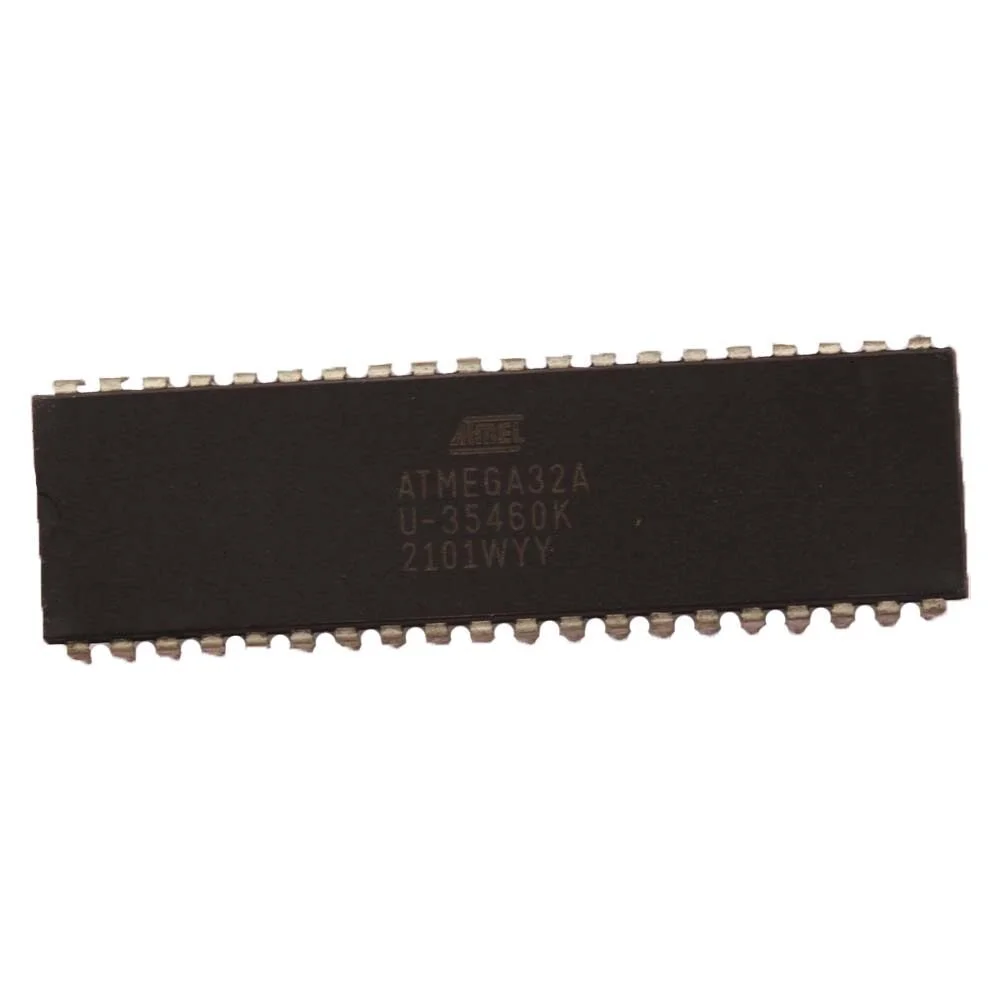
ATmega32 8 Bit ATMEL AVR Microcontroller
₹160.00
ATmega32 8 Bit ATMEL AVR Microcontroller is a high-performance, low-power CMOS 8-bit microcontroller built on the advanced AVR enhanced RISC architecture. By executing powerful instructions in a single clock cycle, this chip achieves throughputs approaching 1 MIPS per MHz. Consequently, system designers can optimize power consumption versus processing speed with high efficiency. Furthermore, the microcontroller combines 32 KB of programmable flash memory with a rich peripheral set on a monolithic integrated circuit. Therefore, developers frequently choose this device for complex embedded systems that require substantial program storage, robust analog interfacing, and high operational reliability.
Key Features:
- High-Performance RISC Architecture: Executes 131 powerful instructions with most completing in a single clock cycle, providing up to 16 MIPS throughput at 16 MHz.
- Robust On-Chip Memory: Features 32 KB of In-System Programmable Flash, 1 KB of EEPROM, and 2 KB of internal SRAM for flexible data retention and code execution.
- Integrated Analog-to-Digital Converter: Incorporates an 8-channel, 10-bit ADC with optional differential input channels and programmable gain stages.
- Comprehensive Timing Channels: Contains two 8-bit Timer/Counters and one 16-bit Timer/Counter with separate prescalers, compare modes, and capture modes.
- Flexible Serial Interfaces: Provides a byte-oriented Two-Wire Serial Interface (I2C-compatible), a programmable serial USART, and a master/slave SPI serial interface.
- JTAG Interface: Supports boundary-scan capabilities, extensive on-chip debug support, and seamless programming via the IEEE 1149.1 standard.
Technical Specifications:
- Core Architecture: 8-bit AVR RISC
- Operating Voltage: 4.5 V to 5.5 V (Standard ATmega32) / 2.7 V to 5.5 V (ATmega32L)
- Clock Frequency: 0 to 16 MHz (ATmega32) / 0 to 8 MHz (ATmega32L)
- Flash Program Memory: 32 KB (10,000 write/erase endurance cycles)
- EEPROM Memory: 1 KB (100,000 write/erase endurance cycles)
- Internal SRAM: 2 KB
- I/O Lines: 32 programmable input/output pins across 4 ports
- PWM Channels: 4 dedicated pulse-width modulation output channels
- ADC Resolution: 10-bit successive approximation with ±2 LSB absolute accuracy
- Operating Temperature Range: -40°C to +85°C (Industrial specification)
Mechanical Specifications:
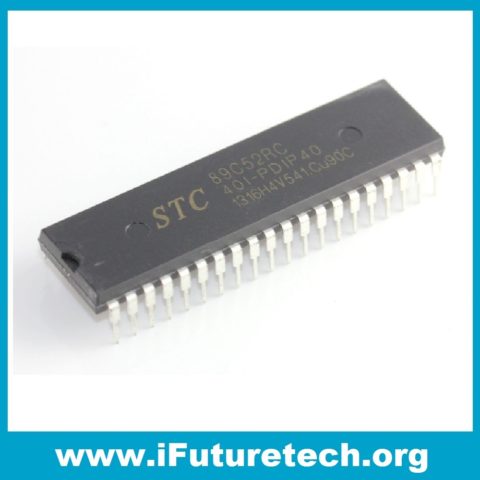
- Package Type: 40-pin Dual In-line Package (PDIP) / 44-lead TQFP / 44-pad QFN/MLF
- Mounting Type: Through-hole (DIP) or Surface Mount (TQFP/QFN)
- Pin Pitch: 2.54 mm (0.100 in) for PDIP; 0.80 mm for TQFP
- Lead Finish: Matte Tin / Lead-Free (RoHS compliant)
Dimensions:
- PDIP Length: ≈ 52.32 mm (2.060 in)
- PDIP Width: ≈ 13.72 mm to 14.22 mm (Body width)
- PDIP Height: ≈ 4.83 mm (0.190 in max)
- Weight: ≈ 5.8 g for the standard 40-pin PDIP package
Pinout and Wiring:
- Port A (PA0-PA7, Pins 40-33): Serves as an 8-bit bidirectional I/O port and acts as the analog inputs to the on-chip A/D converter.
- Port B (PB0-PB7, Pins 1-8): Operates as an 8-bit bidirectional I/O port providing alternate functions for external interrupts, timer outputs, and the SPI bus.
- Port C (PC0-PC7, Pins 22-29): Functions as an 8-bit bidirectional I/O port and provides the JTAG interface connections alongside the I2C bus pins.
- Port D (PD0-PD7, Pins 14-21): Provides bidirectional I/O lines alongside UART communication lines (RXD, TXD), external interrupts, and PWM outputs.
- VCC and GND (Pins 10, 11, 31): Delivers operating voltage and ground reference to internal digital logic circuits.
- AVCC and AREF (Pins 30, 32): Connects power supply and analog reference voltage to the internal ADC; however, AVCC must connect through an external low-pass filter to minimize noise coupling.
- RESET (Pin 9): Initiates a hardware reset when pulled low for longer than the minimum pulse width.
- XTAL1 and XTAL2 (Pins 13, 12): Connects to an external quartz crystal oscillator or ceramic resonator to drive the internal clock circuitry.
Datasheet Reference:
Commonly Used in:
- Development Boards: Serving as the primary central processing unit on legacy AVR development and experimentation platforms.
- Academic Laboratories: Providing engineering students with an accessible architecture to master embedded assembly and C programming fundamentals.
- Industrial Automation Panels: Controlling programmable logic sequences, relay boards, and intermediate sensor interfaces.
Applications:
- Motor Control Systems: Utilizing built-in PWM channels to drive DC motors, stepper motors, and servomechanisms with high precision.
- Environmental Data Acquisition: Reading analog sensors via the 10-bit ADC to monitor temperature, pressure, and humidity in real time.
- Security & Access Control: Handling keypad entry systems, RFID card readers, and digital lock mechanisms reliably; moreover, the non-volatile EEPROM safeguards configuration data during unexpected power cuts.
- Consumer Electronics: Powering audio equipment controllers, smart battery chargers, and display interfacing panels.
Equivalent Models:
- ATmega32A: A modernized pin-compatible replacement with lower power consumption and a consolidated manufacturing process.
- ATmega16: A pin-compatible sibling that provides 16 KB of flash memory for applications requiring less code space.
- ATmega644: An upgraded 40-pin AVR alternative offering double the flash capacity (64 KB) and extra RAM for data-intensive firmware.
- PIC16F877A: A popular 40-pin Microchip PIC equivalent frequently selected for comparable 8-bit control projects.
Package Includes:
- 1 x ATmega32 8 Bit ATMEL AVR Microcontroller (40-Pin DIP)
Additional information
| Weight | 10 g |
|---|
Questions and Answers
No questions have been asked about this product yet. Be the first!
Ask a Question
You must be logged in to ask a question.
Log in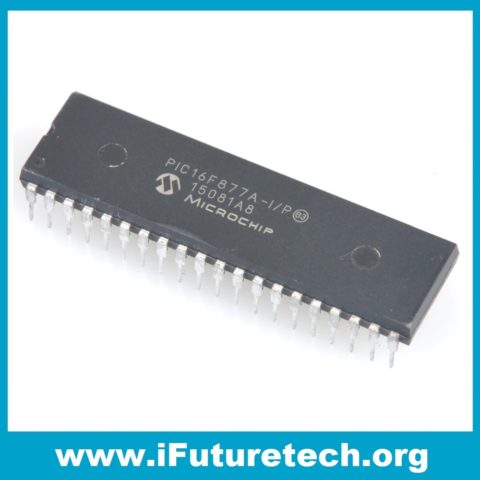

Reviews
There are no reviews yet.